

Pretty much everyone I chatted to at GDC mentioned Crimson Desert, and it’s currently topping the charts for all of its platforms. These are usually good signs. Crimson Desert has been on our radar for a while, as it consistently ranks on our weekly top wishlist ranking, but now hype has reached new levels.
Developed over seven years by Pearl Abyss, the makers of MMO Black Desert, Crimson Desert has evolved from an MMO prequel into a massive, standalone open-world action game. It’s coming to PC, PS5, and Xbox on March 17 for $70.
Set in the war-torn continent of Pywel (nice, Welsh-sounding name😎), Crimson Desert’s gameplay blends high-fidelity combat with deep environmental interaction. There’s so much choice, and the sense of discovery is massive.
One minute you’re flying on dragon back, the next you’re fishing, or piloting a mech. It’s a whole lot of game, and it throws mechanics at the player thick and fast.
The traversal is smooth, and you can tackle challenges in an absurd number of ways, thanks to the game’s robust toolbox made possible by its proprietary engine. It’s definitely taking more than a few cues from Breath of the Wild.
Hype is through the roof, so – if Pearl Abyss can stick the landing – we might just have got 2026’s first big new IP.
With the release date approaching, player interest is already converting into early sales. As of yesterday, Crimson Desert was approaching 400K pre-launch copies sold on Steam, representing gross revenues of $20M+.
Notably, over 10% of those sales occurred in a single 24-hour window yesterday, generating $2.6 million in revenue as the marketing campaign reached its peak. This game could really blow up, if it sticks the landing.
Players are very curious. Pearl Abyss announced that Crimson Desert reached 3M wishlists last week. Our estimates show that around 2.2M of those come from Steam. It’s worth noting that for a successful $70 AAA game, wishlist-to-buyer conversion is typically pretty low, 6-7% a week after launch.
As you can see in the Alinea Analytics platform screenshot (get your free trial!) below, Crimson Desert has netted over 1M new Steam wishlists since the beginning of February, and a whopping 680K this month:
Hype really started to escalate in the past few months, thanks to extensive community building and well-timed announcements. In general, the marketing – including the gameplay reveal and the recent features deep dives – has been great.
But where Pearl Abyss has really hit it out of the park is in quelling vocal online crowds, actively listening to the community, and responding with what gamers really want to hear.
It feels authentic. PR and Marketing Director Will Powers has been the primary face of this effort, adopting a unusually direct communication style. Candidly, it’s refreshing amid the sea of PR drivel we usually get. Authenticity wins.
Here are a few examples that have stood out to me:
-
Genre transparency and managing expectations: To avoid confusion, the devs have repeatedly clarified that Crimson Desert is an action-adventure game, not a traditional RPG. They’ve also vocally avoided overhyping the game, encouraging a grounded perspective. By explicitly stating Crimson lacks features like character creators, branching dialogue, or traditional levelling systems, they’re setting expectations to avoid a Cyberpunk-like launch situation.
-
Detailed specs, with great optimisation: On March 10, Pearl Abyss announced the PC and console specs, following concerns about how the game will run on consoles and mid-spec machines. It seems well optimised and even runs on 10-year-old 1060 GPUs.
-
Showing off the console footage: On March 12, after the community’s continued concerns over a lack of console footage, the team responded by providing unrestricted access to Digital Foundry to showcase the game running on PS5 Pro. DF’s glowing preview helped quell naysayers. Taking things further, Pearl Abyss partnered with PlayStation Japan to show off the base PS5 version.
-
No microtransactions at launch: Given Pearl Abyss’ MMO past, many gamers were worried about Crimson Desert’s monetisation. On the Dropped Frames March 12 podcast, Pearl Abyss marketing director Will Powers said, “I can say that definitively: there is not a cosmetic cash shop. This is made to be a premium experience that you buy and you enjoy the world, and not something for microtransactions … This is a premium experience. That is the transaction. Full stop.”
Pearl Abyss is definitely saying – and doing – all the right things so far, so Crimson Desert is currently tracking very well – even against some stiff competition.
Last year, new IP Expedition 33 (7.5M sold now, 57% via Steam, as per our estimates) won game of the year, while sprawling open-world RPG Kingdom Come Deliverance 2 (5.2M, 69% via Steam) also reached new heights.
Crimson Desert is tracking even better than these Steam-first 2025 big hitters, when we look at launch-aligned data three days before release:
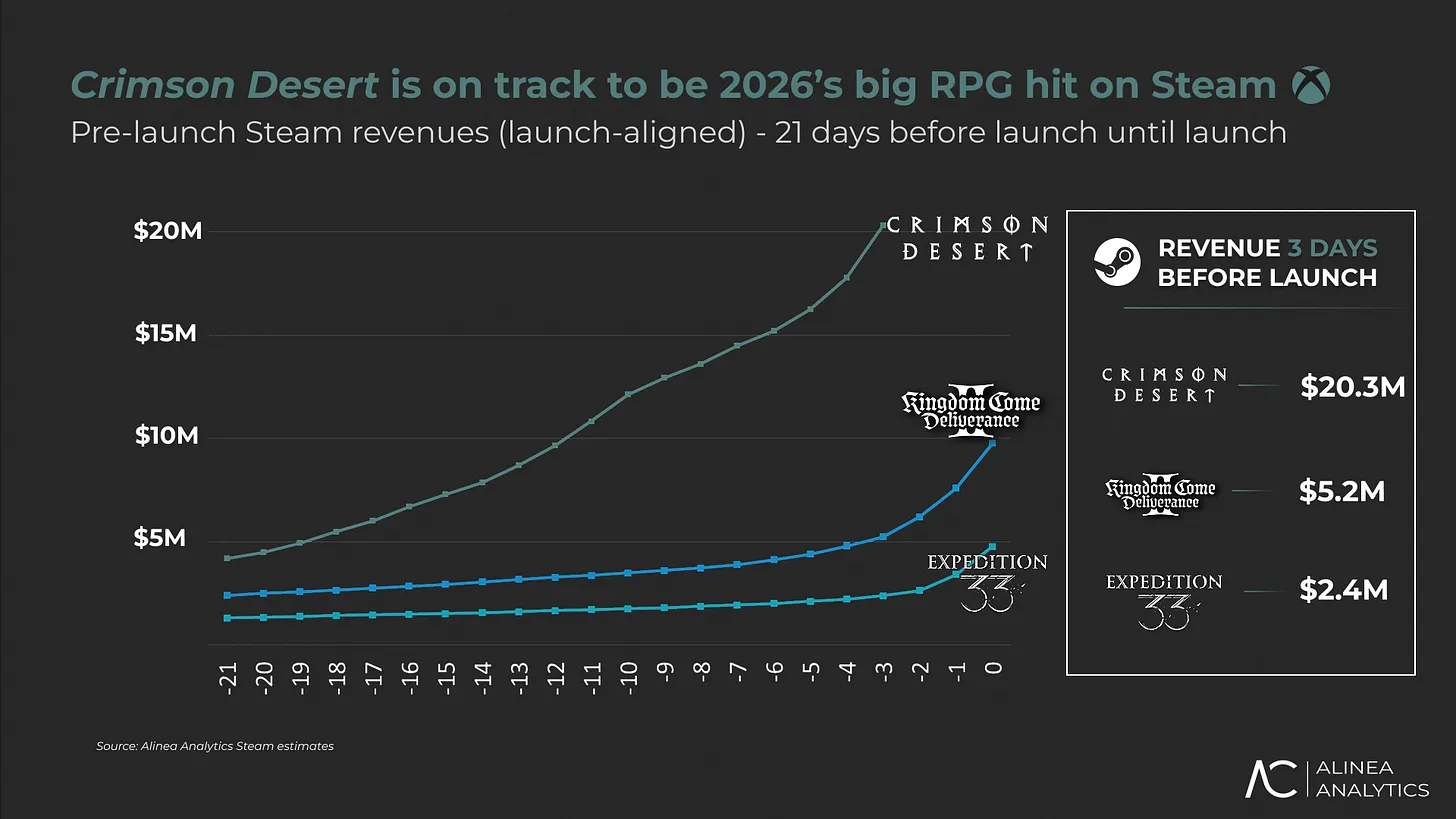
At the three-day pre-launch mark, Crimson Desert’s $20.3M on Steam means it’s outperforming Kingdom Come: Deliverance II by nearly 4x ($5.2M) and Expedition 33 by nearly 10x ($2.4M) at the same point in their respective lifecycles.
That said, it’s worth looking at the longer post-launch tail of revenues to get the full picture:
The longer-term data for Expedition 33 and KCD2 shows that a strong start is only the foundation. Both enjoyed sustained revenue growth – reaching $95.5M and $101.3M on Steam respectively by day 120. And it’s because they delivered fantastic, well-reviewed experiences that fueled long-term word-of-mouth.
For Crimson Desert, the initial hype has ticked all the right pre-launch boxes, but now Pearl Abyss has to put its money where its mouth is. If the quality of Pywel’s open world and its sandbox doesn’t live up to the promising trailers and previews, that momentum will be cut short before it can reach the long-tail success seen by KCD2 and Expedition 33.
Some things in Pearl Abyss’ favour:
-
The sheer variety of gameplay mechanics and emergent possibilities makes it fantastic streamer bait. I’m expecting clips on TikTok galore.
-
Pearl Abyss has a massive built-in audience from the Black Desert ecosystem, providing a safety net of loyal players that new IP rarely enjoys.
-
The localisation strategy is sound. Offering full voiceovers in English, Korean, and Simplified Chinese was smart and will resonate in Asia. We saw this strategy act as a major catalyst for Stellar Blade’s success on Steam.
But Pearl Abyss is missing regional pricing. While the U.S. and China lead the wishlist rankings, Brazil and Russia appearing in the top five suggests a missed opportunity.
Pearl Abyss’ decision to stick to a flat global price risks locking out emerging markets where the equivalent local cost becomes a barrier to entry – a stark contrast to Stellar Blade, which used regional pricing to dominate the Chinese market.
The $70 price tag may also act as a temporary barrier to mass adoption for more cautious players, though strategic discounts down the line will eventually help convert that claim-and-wait audience we often bang on about over at Alinea HQ.
The initial hours are also quite overwhelming in terms of introducing the player to new features, so the first-time user experience might put some folks off. But then again: Elden Ring has sold close to bloody 40M copies.
Ultimately, Crimson Desert’s final ceiling hinges entirely on its execution. The community management and marketing have been sublime, and all pre-launch signals are pointing toward a historic debut.
Assuming they don’t drop the ball, I reckon we’re looking at Steam’s second new 2026 $150M+ powerhouse. Unless the game doesn’t live up to its lofty promises, of course. We’ll be covering its launch metrics (console and Steam) in next week’s newsletter, so hit subscribe below to get that in your inbox as soon as it’s ready.
Before we move on to Xbox, and because a few people have asked, Resident Evil Requiem has now generated over $500M across all platforms, with $225M via Steam. Across Steam, Xbox, and PlayStation, Requiem has sold 5.7M copies, as per our estimates.
I had a blast at GDC this year! Between countless meetings, hosting panels, and running into old friends – and making new ones – in hotel lobbies, I managed to pop over to learn about Xbox’s new ‘’console’’.
As we said to GameSpot earlier this week, Project Helix is the final step in Xbox’s move away from consoles. While it does play Xbox console games, the intention to nudge fans to PC is clear. But it’s not going to be easy.
RAMageddon is real. The GDC stuff touted a custom AMD SoC and a leap in ray tracing, but the market reality is harsh. The generative AI bubble has also blown up the demand for memory, sending component prices skyrocketing. The PS5 Pro already pushed the ceiling of premium hardware pricing – and even the Series X is $650 – so I see Helix coming in at $850 at least.

Historically, Xbox might have eaten that cost to gain market share, but current leadership is hyper-focused on AI, efficiency, and margins. Like most of the tech space, they’ve moved away from the growth-at-all-costs pandemic mindset. My feeling is that if Helix is the bridge to a PC first future, Microsoft will expect consumers to pay a PC-style premium for it.
The market positioning for Helix is muddled. Microsoft is moving directly into Valve’s space here. Project Helix is a direct competitor to the Steam Deck and Steam Machine. Friction is a huge hurdle here for Xbox. SteamOS is elegant and feels like a console, whereas the Windows experience is more clunky. That could change with the imminent Xbox mode on PC, but I’ve not been terribly impressed with my experience on the Xbox ROG Ally X.
Meanwhile, PlayStation seems to be going the other route: doubling down on its walled garden. While Sony will ship live-service titles on PC to find scale, they’re reportedly pulling back their core prestige games to keep them as hardware sellers.
If PlayStation continues to pull back its prestige titles into a walled garden to protect their hardware, they are essentially betting that their IP is more valuable than the reach of the PC market. Given the diminishing returns on PS-made-game sales on PC, that might end up being a smart bet in the wake of the Steam Machine and what Xbox is up to here.
I don’t blame Xbox for its different trajectory, though. Project Helix is a pivot born from the fact that the Game Pass dream has hit a ceiling, which itself was born from damage control from the disastrous Xbox One launch. Also, during the pandemic, the industry overextended and saw risky acquisitions based on the idea that gaming would see eternal double-digit growth.
In 2026, the attention economy is saturated, and the subscription model does not scale in gaming the same way it does in music or film. A user can listen to hundreds of songs a month on Spotify, but they only have time to play a few major games.
Despite Xbox clearly losing mindshare to its competitors in recent years, Xbox still has tens of millions of loyalists with massive digital libraries. Instead of letting them abandon ship to a PC or a Steam Machine when they outgrow the console cycle, Helix allows them to jump ship to a Microsoft-sanctioned hybrid.

It is a way – a lifeboat to keep my awful seafaring metaphor going – to transition their biggest spenders into a PC first ecosystem without losing their library via Play Anywhere. In other words, it’s the final evolution of the strategy started with the Xbox One.
With Helix, Xbox is hoping to capture the flexibility of the PC market while maintaining the plug-and-play loyalty of the console crowd. With a high price tag and the lingering RAMageddon impact, the success of Helix hinges entirely on whether Xbox Mode on Windows is actually a seamless experience or just another layer of Windows bloatware.
If it can’t make this work, Helix risks alienating Xbox’s most loyal fans and leaving them with an overpriced hybrid that lacks the elegance of a Steam Machine or the prestige of a PlayStation. Marketing will also be very important. Hopefully their stepping away from the ‘’This Is an Xbox’’ campaign is a sign that there are brighter things to come there.
Healthy competition leads to innovation. If Project Helix succeeds, it could put more pressure on Valve’s monopoly on PC. Likewise, the industry suffers when Sony and Nintendo are allowed to rest on their laurels without a credible threat to their hardware paradigms.
A successful, high-end hybrid from Microsoft would be a positive thing for the market, I reckon.
We’re offering a free trial of our platform for games companies.
Send us a message here, or reply to this email, and we’ll set you up.
Reply to this email – or reach out here – if you have any feedback for the newsletter – or want to request a game for us to cover.
[Alinea Analytics boasts the most accurate PC and console estimates in the business. Game makers use our platform to understand their audience, keep an eye on the competition, monitor sales trends, and spot new opportunities. We equip game studios and financial institutions with accurate data and the confidence to make smarter, data-driven decisions. Want to talk about all things games market data? We’d love to chat!]


