

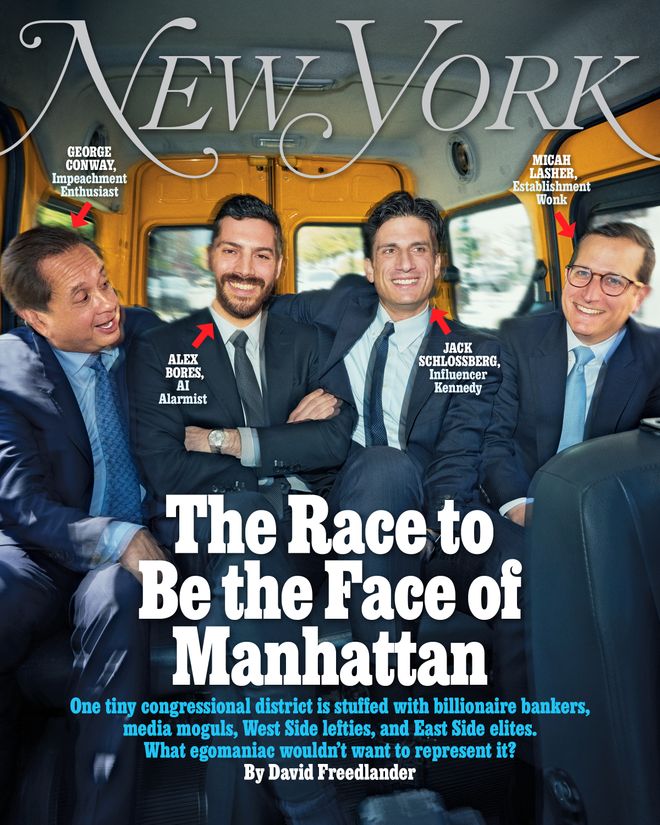
Clockwise from top left: Alex Bores: AI regulation was the hot topic at a supporter’s Carroll Gardens fundraiser. George Conway: At a 92NY candidate forum, the former Republican focused on one thing: impeachment. Jack Schlossberg: The Kennedy heir drew a heavily young and female crowd at his campaign’s March Madness watch party. Micah Lasher: The well-connected wonk is betting that the UWS political machine will deliver him a win.
Photo: Jack Califano
The most important thing to know about the 12th Congressional District of New York is that it should not exist. Since time immemorial, Manhattan was divided in half. There was one congressional district anchored on the Upper West Side, extending down the Hudson and across the harbor to pick up Jewish precincts in Brooklyn, and another centered on the Upper East Side and spreading across the East River to cover part of Queens. One side had Zabar’s, Cafe Luxembourg, Columbia University, and the Lincoln Square P.J. Clarke’s; the other, Elaine’s, the Carlyle, Gracie Mansion, and the original P.J. Clarke’s. But when Albany screwed up the decennial redistricting a few years ago and a judge kicked responsibility for the map to a cartographer in Pittsburgh, this poor fellow looked at these two neighborhoods and saw a very small area crammed with people who were very rich, very white, and very old and smushed them together as if Central Park were a mere slice of greenery and not an 800-acre demilitarized zone keeping two distinct peoples apart.
Chaos ensued. Dogs and cats were thrown together in a single Democratic primary that ran river to river from 96th Street to 14th Street. Specifically, Jerry Nadler, a liberal lion of the Upper West Side, and Carolyn Maloney, a Democrat from the Silk Stocking District with a fierce political instinct but who was perhaps best known for wearing a burka on the House floor and trying to bring pandas to the Central Park Zoo. And they did what any two longtime colleagues in their 70s would if forced to compete for the same job: They attacked with a ferocity that could have lit up the Empire State Building (now conveniently smack in the middle of the contested territory). Maloney accused Nadler, a man so of his neighborhood that he showed up at a Donald Trump impeachment session carrying a Zabar’s shopping bag, of being “half dead”; Nadler allies knocked Maloney as a daffy dupe who bought the Bush administration’s lies about Iraq.
The Race to Be the Face of Manhattan
See All
Nadler won in a landslide, a result in part attributable to just how lopsidedly the new district’s Democrats were distributed. (“Texas has oil, and the Upper West Side has Democrats,” Nadler protégé Scott Stringer likes to say, a remark that makes less sense the more you think about it.) Then, three years later, Nadler abruptly — as much as a 78-year-old does anything abruptly — announced he was retiring. A flood of speculation ensued about who might run: Chelsea Clinton, Andrew Cuomo, Cynthia Nixon, onetime Trump fixer Michael Cohen, and writer and literary scenester Molly Jong-Fast were all mentioned, while every city councilmember and state legislator who had ever represented any portion of the district put out word that they too were taking a look. Even Maloney said she was thinking about mounting a comeback.
“New York-12 is it,” says Jong-Fast, who lives there. “This is a district that is D-plus — I don’t know, some crazy number.” It is D+33, which means no Republican has a shot. “It’s as blue as it gets. But it is also a district that went for Cuomo,” she continues. “It’s Democratic but not liberal. It’s a voting base that is very engaged. You’ve got the MSNBC audience, a lot of Jewish voters, so it’s a lot of elements that are important for the Democrats’ struggle with themselves.”
NY-12 is also the smallest and most population-dense congressional district in the country, one that candidates can crisscross several times in an afternoon. It is among the wealthiest and oldest districts in the United States and is also the district with the most college graduates. It is an ATM for Democrats — something Nadler never fully exploited — and is primed for a politician who can make use of the fact that all the major television and cable-news networks, the New York Times, and The Wall Street Journal are based there.
If you listen to the candidates, the battle for NY-12 is not just about who will be the next member of the city’s congressional delegation but a contest among factions of the island’s Democratic base: the old-money elite, the anti-Trump resisters, the tech-world crusaders, and the old-school party Establishment. While nearly a dozen candidates are vying for the seat, the primary is coming down to just four: Micah Lasher, a state assemblyman from the Upper West Side and a longtime political hand who is Nadler’s anointed successor; Alex Bores, an assemblyman from the Upper East Side whose calls for AI regulation have led to millions of dollars being spent both for and against him; George Conway, the onetime Republican lawyer who has achieved notoriety as a leader of the #Resistance; and a previously little-known social-media influencer who is trying to rewrite the rules of New York City politics.

Schlossberg surrounded by supporters at a campaign party.
Photo: Jack Califano
“It’s New York-sized,” that social-media influencer, Jack Schlossberg, said when asked why this campaign is different. He was sitting in a diner near his apartment in Chelsea, eating a late breakfast of a plate of bacon, which he finished before absentmindedly spooning up the grease with his forefinger and licking it. Schlossberg’s presence in the race proves the point. The 33-year-old grandson of John F. Kennedy, son of Caroline, nephew of John Jr., and scion of America’s faded royal family, Schlossberg was previously known to the public mostly from a series of baroque viral videos. In one, he is shirtless and dancing provocatively at the beach, his shorts pulled just below the tan line, his finger perched on his pouty lips. In another, he puts on a wig and pretends to be Melania Trump talking to Vladimir Putin. In a tweet, he asked who is hotter, Usha Vance or Jackie Kennedy — his grandmother, to be clear. He also mused on X about Jesus’ apparent challenges with putting on muscle (“Most popular guy of all time — not jacked. Toned, but not big. So my question is — did Jesus want to put on muscle but couldn’t? Or was he lean on purpose?”). After the hosts of Pod Save America conducted a reputation-washing interview with the leaders of Kamala Harris’s failed presidential campaign, Schlossberg wrote that they should all “Podsave my limp dick.”
When I sat down, I was bracing for an unpleasant meal. In person, though, Schlossberg is little like his online self. “I spent the first 30 years of my life inside a library,” he says. He comes across as serious and smart. Schlossberg graduated from Collegiate, where, according to schoolmates of his, he never talked about his pedigree and it was an unspoken rule not to bring it up. From there, he went to Yale, then to a job in Tokyo with Suntory, the liquor company, and then to a posting at the State Department while his mother was ambassador to Japan. After that, he earned a dual business-and-law degree from Harvard. (None of this would be in evidence from his LinkedIn, which lists his current job as “Director of the CIA” and his work experience as “Special Assistant to Lauren Boebert” and a flight attendant with Pan Am; Harvard Law is noted, but Schlossberg says his role there was “dermatologist.”)
The social-media antics were, in his telling, just a way to crack the algorithm. Clout is the coin of the digital realm, and the way to get it is by getting attention. While, early on, most other members of the Kennedy clan thought it unseemly to publicly criticize Robert F. Kennedy Jr.’s increasingly conspiratorial musings and eventual Trump alliance, Schlossberg tore into his cousin, whom he told me he barely knows. In a series of Instagram videos, Schlossberg assumes various personas, including that of a Masshole for whom RFK Jr. is despoiling the family name (“You know, I’m a fan of his father. And you know his uncle? Rest in peace, I remember where I was the day he was killed. I mean, it was a tragic day, the entire country wept. But listen, that guy, he’s a prick. The new guy, the young guy, he’s a friggin’ prick”).
“Jack stood out as someone willing to stick his neck out,” says a senior Biden campaign official. “Everyone else was concerned about protecting the Kennedy brand. It looked completely unhinged to me, but there was a method to the madness.”
By the time Schlossberg showed up at the Democratic National Convention in 2024, where there were special-access passes for influencers, he was mobbed by fans. “I had this experience where, although I grew up in a famous family, I myself wasn’t recognizable or famous. People started recognizing me everywhere I went,” Schlossberg says. “I couldn’t go anywhere at the DNC without getting swarmed, and I realized that I get how to do this so that people respond to it.”
Schlossberg endorsed Zohran Mamdani two weeks before the mayoral primary, the only NY-12 candidate to do so (Lasher and Bores endorsed him after the primary), and there’s a Zohran-like vibe to his campaign events, minus the ideological fervor. One Sunday morning in late March, I went to a party Schlossberg hosted at a Tenth Avenue pizzeria. Eighty people showed up — all of them new to any Schlossberg event — and another 150 were on the waiting list. A strong majority were women under 30. As Schlossberg made his way from table to table, they gazed at him dreamily.
I spoke to one woman who was a freelance choreographer, another who was a graduate student, and another who worked at Trader Joe’s after being laid off from a museum job. Many were new to New York and to politics, and many lived outside the district but were looking for something to get excited about. No one cared about Schlossberg’s lack of experience — many were looking for jobs themselves — and all mentioned some connection (usually from a mother or grandmother) to the candidate’s famous family.
“This is way more fun just being on your phone and talking shit,” Schlossberg said at the end of the event, standing on a table to address the crowd. “We can win. We are running against someone who is taking money from billionaires, hand over fist, and saying that they’re gonna go to Washington and fight corruption. What a joke. We’ve got another guy who says that he’s gonna regulate AI. That sounds nice, and then he goes and he takes a million dollars from an AI company. All we want is for you guys to come here, make friends, and then, when you leave, go to the polls in June and vote for Schlossberg.”
In addition to the young demographic, Schlossberg does well with famous people. A few weeks later, at a meet and greet at Chez Nous, a French restaurant in the back of the Marlton Hotel in Greenwich Village, Amy Sedaris, Rick Moody, Michael (son of Norman) Mailer, Alexandra (daughter of William) Styron, and some 70 guests gathered, many saying they had known Schlossberg since he was a baby.
“And I was an amazing baby,” he told the crowd. “In no small part because of all the people around me who loved me and cared about me.” He name-checked the event’s hosts, including the novelist Susan Minot and Wendy Goodman, the design editor of New York.
He told the group how he planned to win — not through social media, as his history might have suggested, but through small gatherings like this one. “The great privilege I have in life is to be connected to a tradition of public service. People come up to me with tears in their eyes, saying that my grandfather, my uncle Teddy, inspired them to enter public service,” he said. “I think the Democratic Party needs to do a little bit better. I love my party.” He told them how he went to work for the Biden campaign in 2023: “At the time, I was like the only huge young Joe Biden fan out there” — and the only one making content for the internet, a place that was becoming, in his telling, increasingly right-leaning. He said he’d tried to counter this with Schlossbergian pro-Biden content (“I am going to talk to a dog about health care”), but the campaign wanted to play it safe. Not until Harris became the nominee could he let his Jack flag fly and talk to voters in his way. “There was nobody out there speaking their language, meeting them where they are, making it fun,” he continued. “The old rules don’t apply. We have to come up with something new.”
“It’d be nice to have someone who goes back to these kinds of moral and visionary impulses,” the actor Griffin Dunne told me after the speech, recalling how as a kid he had written letters to President Kennedy, letters that the president’s own secretary replied to. “I think a lot of leadership is just genetics.”
This is the unspoken premise of the Schlossberg campaign, that the right order of the universe is restored when Kennedys are in Congress or political office somewhere, something that was true for 74 years of American history but not for the past five, ever since Cousin Joseph P. III gave up a House seat and failed in a Senate run in Massachusetts. The Kennedys are, among other things, a vehicle for nostalgia, and Democratic strategists believe Schlossberg is benefiting from the warm feelings generated by Ryan Murphy’s hit series Love Story, about the 1990s life of his late uncle (which he calls a “stupid show”).
Members in good standing of the Democratic Establishment are aghast. This is a seat whose lineage stretches back to Bella Abzug and Ed Koch. The Establishmentarians can’t believe it could go to someone like Schlossberg. “This is a guy who has never had a meaningful job, who has never done meaningful work in the district, and who only seems to be good at making videos and is now asking people to vote for him,” says Chris Coffey, a Democratic operative who, like most other ones in town, supports Lasher. “If he weren’t a Kennedy, he would be an erratic 33-year-old and we wouldn’t possibly be talking about him as a front-runner in this race.”
But live by the social-media algo, die by the social-media algo. NY-12 is one of the most Jewish districts in the country, and despite its liberal leanings, it’s thought by strategists to be slightly to the right of the current Democratic Party on this particular issue, a fact reflected in the candidates’ nearly identical positions on Israel. But when Schlossberg said he would continue to support defensive funding for Israel on a popular podcast, he faced a torrent of online criticism. Late last month, he was confronted by the social-media performance artist Crackhead Barney, who asked him to say “Free Palestine” or even “Fuck Israel.” (“No way, dude,” Schlossberg responded. “I am Jewish.”)
Angelo Roefaro, a longtime aide to Chuck Schumer, has been serving as an unpaid adviser to Schlossberg. Schumer put Schlossberg on the America250 Commission, a Senate-confirmed post at which Schlossberg was helping to plan the semiquincentennial until Trump trashed it in favor of his own commission. After announcing his run, Schlossberg churned through campaign staff and consultants before hiring Alex Voetsch, a strategist who became controversial in Democratic circles after his firm did work for Kanye West’s 2020 presidential campaign.
People familiar with the campaign say Schlossberg has a tendency to disappear, going weeks without media hits and rarely alerting the press to his campaign events. Set to drop the day he announced, a launch video his staff had laboriously put together was scrapped at the last minute, as was a policy platform. (“Everything is a draft until it’s not a draft,” a spokesperson for the Schlossberg campaign says.) A personal assistant whom Schlossberg had been paying to help with his online presence was put on the campaign’s payroll. Still, working for Schlossberg can be a heady experience — Lorne Michaels and Bette Midler are donors, and Antony Blinken is available for input on Middle East policy questions. The campaign paid $16,000 for a logo design, something political consultants usually do for free as part of their services.
“When he turns it on, there is just nothing like it,” says someone formerly involved with the campaign. “But he clearly has a problem turning it on.”
When I ask Schlossberg about staff turnover, he says it occurred after he announced his candidacy because “I figured out how corporate campaigning is and how stupid it is, and that’s the reason why everyone is so lame.” Then, adopting the voice of a beseeching candidate: “ ‘Could I please have one launch video? And one consulting firm for media and one consulting firm for compliance, one for digital comms?’ It’s just crazy. You hire ten consultants, and they get paid based on how much ad space you buy. And I’m not doing it that way. Recently, I promoted someone to manage my campaign, but I’ve been the campaign manager the whole time. We don’t have anyone helping with our press. I do all of that. We’re a start-up completely different from any other candidate.”
When I ask about the criticism from his rivals that if he really wants to enter public life, he should start somewhere humbler than the august ranks of Congress, he volleys a question back at me: “Would that make me a better congressman?” Referring to Lasher and Bores, he says, “Based on what the job is right now, does that make them better prepared? And I would point out that between them they have only completed one term in office.”
This is true — Lasher was elected to the State Assembly in 2024 and Bores in 2022. But in Lasher’s case, at least, that’s a little misleading.

Lasher enjoys the attention of a throng of his own supporters at a campaign fundraiser.
Photo: Jack Califano
“I can’t help but feel like I am going to emerge as a fairly boring character in your story,” Lasher tells me when we sit down for our own late breakfast at a diner on the Upper West Side. Lasher is, as Michael Kinsley once said of Al Gore, an old person’s idea of a young person: a 44-year-old still fresh-faced enough that while the Upper West Side grandmothers who recognize him and interrupt our breakfast don’t exactly pinch his cheeks, you get the sense they wish they could.
Lasher was practically raised by the neighborhood’s political infrastructure. He spent his early childhood on the Upper West Side but moved to New Jersey when he was in grade school. He was miserable, and after coming back to the city for the bat mitzvah of a friend, he timidly asked his parents if they had ever thought of moving back. Turned out they were miserable in the suburbs too, so the whole family returned. Lasher, like Nadler, attended Stuyvesant High School. At 15, he volunteered for the Manhattan borough-president campaign of Deborah Glick, the first openly gay member of the New York Legislature.
The campaign was essentially an extension of ACT UP and the AIDS activism happening in ’90s New York. He became part of the top brass and stepped into the political world in earnest, working after that on a series of City Council and mayoral campaigns as well as on Andrew Cuomo’s aborted 2002 gubernatorial run. Lasher was still in college at NYU (“I wasn’t a very good student,” he says) when he teamed up with Josh Isay, one of the top political operatives in the city (who once advised Caroline Kennedy when she embarked on an ill-fated effort to be named the Senate replacement for Hillary Clinton), to start a political-consulting business, Knickerbocker Partners. They named it after the downtown restaurant where they would meet. The firm quickly became the go-to not just in New York but for Democrats around the country.
Lasher eventually tired of political consulting. He wanted to do something more substantial, so in 2007 he sold his portion of the company (which would eventually merge with some Washington powerhouses and become SKDK) and went to work as an aide to Nadler. Before he turned 30, Lasher had become part of the leadership of the New York City Department of Education and Mike Bloomberg’s top aide in Albany. Jobs as chief of staff to Attorney General Eric Schneiderman, campaign manager for Stringer’s first mayoral run, and a top aide to Governor Kathy Hochul followed.
All of which is to say there are a lot of elected Democrats in New York who really want Lasher to be the next congressman. Nadler has endorsed him, as have Hochul, former governor David Paterson, and Bloomberg, who gave $4 million to a Lasher super-PAC. More than a dozen politicos gathered in front of more than 100 supporters on a spring Saturday on 72nd and Broadway for a Lasher rally to kick off the final 100-day sprint to Election Day. Brad Hoylman-Sigal, the Manhattan borough president, spoke, as did the borough president before him, the borough president before him, and the borough president before her. “I don’t want to see someone go to Washington who wakes up in the morning and goes like this,” says Stringer, the BP thrice removed, while making a gormless face in front of an imaginary iPhone. “Who checks the latest poll, who only understands policy based on what’s on TikTok. I want somebody who gets it. The good news is we have this district, which is the most intelligent in the country.”
The presence of all of those boroughwide officials speaks to the strengths Lasher has in the race. Although he has trailed Schlossberg in most private and public polling, the betting markets have him as a slim favorite. Schlossberg’s rivals also believe his early lead is a mirage, a result of high name recognition; as the rest of the field starts spending on advertising and becomes as well known as Schlossberg is, it will collapse.
Schlossberg’s clearest path is to turn the race into a capital-T Thing, in which the endorsements from labor unions and political clubs don’t matter much because of the pure star wattage of his candidacy. The lines outside his events are decent proof of concept. But is becoming the favorite candidate of the young and glamorous actually a winning formula in a district so old and, frankly, sedate?
Lasher is taking the other side of that bet and running something of an anti-charisma campaign — an approach he believes is perfectly suited to a district filled with hyperinformed voters. Instead of doing bits on TikTok or dancing shirtless, he is posting videos on Instagram, say, of himself in Central Park wearing blue jeans and loafers, patiently explaining how he battled Airbnb as a government official. (As of this writing, it had four reposts and 101 likes.) When I ask Lasher his thoughts on the Democratic Party in the age of Trump, he points me to a 5,500-word essay on his Substack, appropriately titled Into the Weeds.
“I like to say to our team, ‘Our brand is nerd,’” Lasher says. His reputation as something of a wizened political whiz kid is well earned. The Central Park video may not have gone megaviral, but Airbnb evokes a lot of animosity in the district, and its biggest opponent is the hotel-workers union, which happens to be a useful endorsement. In 2024, Lasher made the unusual move of leaving a senior position with the governor to be a backbench member of the State Assembly. There, he worked to counter Trump’s redistricting efforts in Texas and to curb the administration’s policies on immigration and vaccine access.
“I think voters are looking for leaders who can take the fight to Trump. Jack and George in nontraditional ways are making an argument that they’ve demonstrated their ability to do it in one context — social media, communications. Which is important. And I’ve demonstrated it in a context that is more relevant to the job at hand, which is in a legislative body,” Lasher tells me at the diner while eating a late breakfast of grilled cheese and French fries. “Who is going to be the most effective member of Congress in using the powers of Congress to fight back against this? That is a case that I believe will be persuasive in one of the most educated, sophisticated congressional districts in America.”
It can sound almost quaint, this belief that endorsements from current and former elected officials will win races and that what voters yearn for is experienced legislators with sober demeanors and sound policy plans. But Lasher and his allies believe it can still be true in a congressional race and especially in this one.
“Those other guys are going to fade,” Nadler tells me. “Schlossberg’s got a lot of free publicity on TV — not cable but regular television — because of his grandfather. But that’s gonna fade. He’s got nothing to point to. I have nothing against the Kennedys and Kennedys in politics, but it should be someone with a record, who’s done something, and he hasn’t. Conway got a lot of initial publicity, and he may be anti-Trump, but he’s a conservative Republican. That’s not going to win this district. I’m not sure who Micah’s major opponent is going to be. It won’t be them, all right. It might be Bores.”
Part of what makes the race such a political junkie’s delight is that the stakes are so low. This isn’t a presidential contest, or a mayoral contest, or even a swing-seat congressional race. It’s a primary between four liberal but not left Democrats with similar views on the issues. The battle is really about what wins elections in Manhattan in the Mamdani era. Can social-media savvy beat experience? Does the West Side political machine still matter? Is there anything more important than impeaching and removing Trump? Can a bunch of GOP-aligned tech-industry donors alter the contours of a race in a deep-blue district?
“We are going to find out on June 23,” says Bores, who represents a district that runs down Park Avenue from Carnegie Hill to Murray Hill. He is the first member of the State Legislature with a graduate degree in computer science. Before being elected in 2022, he worked for a couple of start-ups and, before that, at Palantir, leaving when the data behemoth renewed its contract with ICE. At that point, he fell in with the effective-altruists crowd, a downtown-centered social scene of data scientists and would-be philosophers who claim to take a scientific approach to solving the world’s most intractable problems.
“I buy into the idea that we should all evaluate how we can do the most good and apply rigor to that analysis. And people come to different conclusions as to what the best way to apply it is,” Bores tells me. The effective-altruism network included Sam Bankman-Fried and his brother, Gabe, whose super-PAC gave more than $100,000 to boost Bores’s first run for office. One of EA’s primary concerns has been the regulation of AI, and once Bores got to the State Assembly, he became the lead sponsor of a bill, the RAISE Act, that set safety and transparency standards for AI, something that so angered AI firms they’ve poured millions of dollars into this race to defeat him.
“There were a few Trump megadonors that really didn’t like that — Marc Andreessen, Ben Horowitz, and Greg Brockman, the president of OpenAI, who, in the second half of 2025, was Trump’s single-largest megadonor. They believe there should be no regulation of AI whatsoever,” Bores told a small and tech-savvy crowd at a fundraiser in a Carroll Gardens brownstone in March. “And they gave Trump a bunch of money and, in exchange, got an executive order to punish states for trying to regulate AI and targeted a number of bills, including the RAISE Act. So in a race where we’re all promising to fight Trump, I am the only one that his megadonors are fighting back against.”
Bores told me he did not intend to become the AI candidate in this race. He wanted to campaign on health care, housing, and good-government reforms. Bores has unveiled ideas about how to use the powers of the federal government to mitigate the worst excesses of the coming AI storm, such as insisting that AI companies pay for green technology to run data centers and, in a world where AI renders work as we know it useless, giving the government a “golden share” in the companies’ profits to fund some form of direct payments to Americans. In the process, he has become a glaring example of the ways in which outside spending groups are swamping American politics this year. Leading the Future, the super-PAC operation funded by OpenAI and Andreessen Horowitz, has raised $140 million and made Bores its top target.
“Leading the Future is trying to make an example of Alex,” says Leah Hunt-Hendrix, one of the hosts of the fundraiser and a top Democratic donor. There is a way, though, in which the super-PAC spending has given Bores a boost: It has made him something of a national voice on AI regulation. He has appeared on major podcasts like Ezra Klein’s and Josh Barro’s and done spots on CNN. He has been profiled by Politico, Vanity Fair, and Fortune.
And the more OpenAI and Andreessen Horowitz have spent, the more Bores’s allies have responded in kind. Since that fundraiser, and with the election just seven weeks away, Chris Larsen, a billionaire executive at the crypto giant Ripple Labs, has announced that he is going to spend $3.5 million on behalf of Bores, telling the New York Times that he was motivated to do so after seeing the onslaught that Vlasto’s super-PAC was unleashing against him. The first ad that Larsen’s super-PAC, called You Can Push Back, produced features a young boy lying on the floor of his TV room looking at an iPad. “You think you know what they are watching, but with AI, they can land on anything,” a female narrator intones over an eerie soundtrack. “Violence, child sexual abuse, and predators. Who would be against AI safety laws? OpenAI. The company behind ChatGPT. They’re attacking Alex Bores for writing the toughest AI safety law in the country. Don’t let OpenAI shut down child safety.”
The involvement of Larsen, who lives in San Francisco, marks a significant escalation in the stakes of the race: Not only is the contest on track to become one of the more expensive Democratic congressional campaigns in the country, but the forces aligned with Bores are now on pace to outspend those aligned against him in a campaign that can sometimes resemble business warfare by other means.
Bores’s opponents say he isn’t so much bravely taking on the AI companies as shilling for a specific one, Anthropic, which has strong ties to the EA world. They point out that not only is the pro-Bores, Anthropic-backed super-PAC network also spending huge amounts of money on the race, but most of Bores’s early fundraising haul came from Anthropic-affiliated figures in Silicon Valley. At a candidate forum near Columbia in February, Lasher tore into Bores, arguing that while Bores passed a bill on catastrophic risk, he was the only Democrat to vote against a bill Lasher co-sponsored to regulate AI in the workplace and another to regulate AI in lending. “We are not going to see either of the two major AI companies in this country supporting my campaign,” Lasher said.
If the candidates all chose to meet for breakfast at diners in the daylight, it’s only fitting that the main political operative whose work is altering the contours of the race wanted to meet in the back of Donahue’s, a dark-paneled 75-year-old steakhouse and bar on the Upper East Side. Josh Vlasto did long stints as a spokesman for Schumer and Cuomo, then pivoted to a career in tech after Cuomo stepped down in the wake of sexual-harassment allegations (allegations Cuomo denies). In the years since, Vlasto has emerged as a spokesman for Fairshake, a pro-crypto super-PAC, and more recently as one of the top strategists behind Leading the Future.
To hear Vlasto tell it over light beers before he dashes to a Knicks game, the battle in NY-12 is not between little guy Bores and a bunch of big tech companies; it’s between big tech companies. Vlasto says that his super-PAC is pushing for a level playing field and a nationwide set of rules that will apply to everyone, harness the power of AI for the country’s economic benefit, and keep the U.S. competitive with China. Rather, it is “the doomer weirdos” behind Bores’s super-PAC and the candidate himself who are framing the fight as David against the tech Goliaths, though they’re really just trying to game the system for their own advantage. (“Alex Bores is proposing regulations that apply to everyone,” a spokesperson for the campaign says.)
Had Harris won in 2024, the entire AI industry would have been obliterated, save for Anthropic, says Vlasto. But Trump won, so, Vlasto says, Anthropic looked to the states to get the favorable regulatory regime it was after. (A spokesperson for Anthropic denies this and says Anthropic has been clear about its preference for a national AI standard.) Vlasto says his donors and other players in the industry were trying to negotiate with Bores in good faith on his AI bill until they concluded he was too closely aligned with the Anthropic-EA world. “We realized what he was up to, and it was ‘Okay, now he’s our target. He’s not working with us. We know he’s deep with Anthropic because they are trying to support their allies in the states. Let’s get out in front of it.’ So we have determined that he is only advancing an agenda to serve one company,” Vlasto continues. “He is totally controlled by a fringe element of the tech community. I have achieved my first goal, which was to show and expose who his funders are, who his donors are, and the network that he comes from. And the second goal is to defeat him, which we are on track to do.” (Of Vlasto’s account, a Bores campaign spokesperson says, “This is a hallucination so detached from reality that only AI could have come up with it.”)
Strategists inside and outside the Bores camp have suggested that all this negative advertising is actually helping him, and advisers point to internal polls showing him in second place among voters who said they had seen a negative mailer about him and in the lead when the sample was narrowed down to voters who said they were familiar with all four candidates. But one private poll shared with me found Bores to have as high an unfavorability rating as any candidate in the race, despite not being very well known. In any case, the negative attention has forced him to talk relentlessly about a subject few voters seem to know or care about. According to one rival campaign, when voters were polled on their top priorities for their next member of Congress, including the environment, health care, and the like, AI regulation came in dead last.
This is not a district like most,” says one pollster. “You go around the country and the No. 1 issue is affordability and the cost of living, and those are the 8,000th-most important issues in this district, which is filled with affluent white liberals who are singularly obsessed with what Donald Trump is doing to our country.” Each of the candidates can make a claim as to why they are the anti-Trump. The Schlossberg camp says that Trump is singularly obsessed with the Kennedy family and that electing Schlossberg would gall the president to no end. Lasher talks about the work he has already done trying to rewrite the State Constitution to allow mid-decade redistricting and curb the power of ICE. Bores points to all the Trump donors who are funding Vlasto’s super-PAC.
But if one candidate in this field is really and truly anti-Trump, almost to the exclusion of everything else, it’s Conway. A longtime Republican attorney, Conway was involved in the GOP efforts to bring down Bill Clinton over the Monica Lewinsky scandal. And, of course, he was married to Kellyanne Conway, the onetime pollster and pundit who in 2016 joined Trump’s campaign and then his White House staff.
Soon after, George became a leader of the #Resistance and one of Trump’s most vocal critics. The Conways’ marriage became an object of fascination: How could they keep it together? The answer was they couldn’t. So George did what rich, middle-aged men have long done after a divorce: He moved to Manhattan. Equipped with a dog and a girlfriend (the author and child psychologist Ellen Braaten, who, he notes, lives on Central Park West), he moved into a new development in Hudson Yards and ran for Congress.
It’s in some ways the most relatable of experiences for this bizarro era: a relationship ending over Trump. “I regret my wife not leaving the White House when I said she should,” he says. He wishes the nation hadn’t had a front-row seat to his marital psychodrama, but he couldn’t watch Kellyanne defend Trump on the news every night anymore. He recalls one moment in particular, when the New York Times published a 5,000-word investigation into Trump’s personal-income-tax records and Kellyanne went on TV to call the story false: “I was like, ‘What are you doing? First of all, there’s no way you know whether it’s false or not because you didn’t have time to actually read the story. And, two, this is not a White House thing. You should be referring the reporters to his personal lawyers because this is not your job. You work for the United States of America, not that piece of shit.’ I didn’t say this to her at the time, but it just made you want to pull your hair out. And at some point I said, ‘I can’t take this.’”
He became something of a celebrity in his own right, and the story of his rise to prominence is documented in podcast interviews, magazine profiles, and articles he wrote for The Atlantic.
In this race, Conway’s base isn’t so much geographic as tribal, a loose network of MSNBC watchers, The Bulwark readers, and Pod Save America listeners. “I started following George when he started speaking out against Trump years ago, and we sort of became Twitter friends. And I just always admired the fact that he kind of put his whole career, and his marriage, on the line to support democracy,” says Morgan Fairchild, the ’70s and ’80s TV actress who also emerged as an anti-Trump voice on social media.
Facing two opponents in their 30s and a third in his 40s, Conway, 62, is running something of a yolo campaign. “If instead of deciding to become a lawyer, I’d decided to pursue my interest in politics and go into politics, I’d be really stressed out right now. But I just have no fucks to give,” he says. “You want to vote against me, it’s your loss. I am probably going to find some other way to help and probably go skiing a little bit more.”
Conway first has a lot to answer for, including not just those years spent as a Republican (he was giving Trump the benefit of the doubt well into 2017) but the fact that he was still living in Maryland when Nadler announced his retirement.
Sitting in the office of the political-consulting firm he hired to help with his campaign, Conway tells me he resents the notion he is some kind of carpetbagger. He ticks through his New York City addresses as if he’s filling out a form for a bank-loan inventory; the list ends at Trump World Tower, where the former couple bought an apartment (after that, they moved out to the suburbs to raise their children).
Central to Conway’s pitch is that Trump is a uniquely authoritarian threat who needs to be removed from office. Most Democrats in the district agree with him, but leaders in the House have tamped down impeachment talk, fearing it will turn off swing voters. Conway says he aims to do this in his first term and then serve one more to try to codify into law a remedy against future presidential abuses.
There has been no independent polling in this race. A February poll sponsored by Conway showed him in second, with 16 percent of the vote, behind Schlossberg, who netted a quarter of the respondents, while Lasher and Bores were both at 11 percent. A March poll sponsored by Bores had himself in second place, also behind Schlossberg, but with Conway now in fourth and Lasher in third. Another private poll shared with me showed Lasher in first with Schlossberg and Bores just behind. Few put much stake in these early polls, though, all of which were conducted before any candidates or their affiliated super-PACs had really started spending money on the race. Betting markets have Lasher ahead of Bores and Schlossberg but still at less than 45 percent likely to win.
Lasher’s ties to the West Side political network should deliver him a sizable chunk of votes, and his many endorsements will signal to less-informed voters that he comes well recommended. The rest of the field is fighting over what’s left: younger voters, voters disaffected and disconnected from politics, voters for whom Lasher’s long career in politics is more of a minus than a plus. Lasher may present himself as having the deepest understanding of the mechanics of government, but they all have their pitch. Schlossberg would be an ambassador to the hyperonline generation. Bores would bring a computer scientist’s approach to curbing the powers of the tech oligarchs. Conway would annoy the hell out of Trump.
At a recent sold-out candidate forum at 92NY, Conway made his impeachment appeal, only to be interrupted by Lasher, who said there was no world in which the Senate would convict Trump. Schlossberg then interjected, too, saying Lasher’s unwillingness to say Trump should be removed showed his timidity and revealed what was wrong about the Democratic Establishment.
Lasher was beside himself. He tried to explain the math problem, how there would need to be 67 votes in the Senate to remove Trump and how that wasn’t going to happen. He is factually correct; there weren’t the votes to convict him after January 6, and Trump has only two years left anyway. But there on the stage were Conway and Schlossberg painting pictures of Democratic routs in November, of a country that had finally come to its senses, and there was Lasher explaining the inconvenient reality.
Any of his fellow candidates peddling this scenario were lying to the Manhattan voting public, he said. Before he got into politics, Lasher was a child magician and wrote a book on doing tricks. He now said his opponents should level with voters about how, absent some kind of magic trick, they’d never be able to remove Trump from office.
“Not with that attitude, at least,” replied Schlossberg. The audience cheered.


