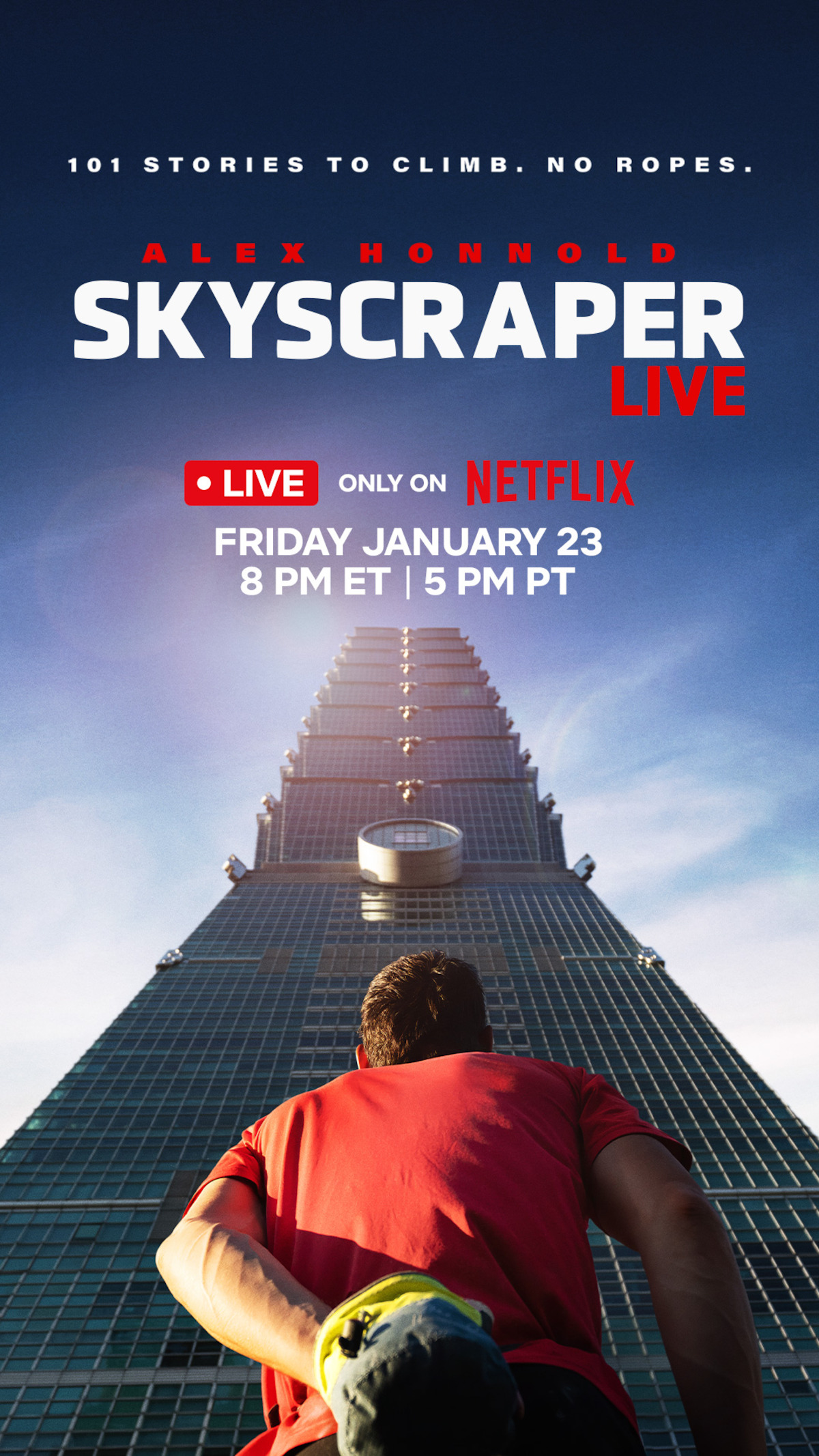
On Jan. 23, Alex Honnold will step onto the exterior of Taipei 101 — 1,667 feet of glass, steel, and concrete — and attempt to climb all 101 floors without ropes. He’ll do this live on Netflix in Skyscraper Live, a two-hour global event.
In a shift from the granite walls that made him famous in the Oscar-winning documentary Free Solo, this might be his most unpredictable challenge yet. Skyscrapers are steeper and more repetitive than most natural rock faces, the movements tax his body in a different way, and he’s simply never climbed a building this big before.
Ahead of the live event, Honnold spoke with Tudum about why he chose Taipei 101, the 64-floor section he calls the “bamboo boxes,” how he manages fear in real time, and what success looks like now that he’s older, more methodical, and a father.
Below, read our full Q&A — lightly edited for clarity and grammar, but otherwise in Honnold’s own words.
You’ve climbed the most unforgiving rock faces on earth. Why a skyscraper, why Taipei 101, and why now?
Alex Honnold: Why not? Taipei 101 because it’s amazing and it’s an incredible building. It’s possible, which a lot of skyscrapers aren’t — it’s uniquely suited for climbing.
Now, because it’s really hard to get permission to climb a building and I have permission, I have to take advantage of it and climb the building. Basically, it’s just rare to get this kind of opportunity, so you gotta jump when you can.
What mentally clicked for you when this challenge was proposed — excitement, curiosity, hesitation?
Honnold: I think I’ve always had curiosity about what it would feel like to climb a building this big. I’ve climbed tons of huge walls in the world but never something man-made like that.
Also, buildings are steeper than most rock faces. Most rock faces, even the ones that look vertical, aren’t actually vertical, or they’re not vertical for the whole way — whereas the building is vertical the whole way, so it’s cool. It’s just a difference, and it’s exciting.
-
News
The heavyweight showdown is finally here — follow every moment as it unfolds.
By Amanda Richards
Dec. 23
-
News
Here’s who’s playing this time around.
-
News
“There’s a danger to romance. Here, that danger is material.”
By Amanda Richards and Roxanne Fequiere
July 19, 2024
How does free soloing a building differ from a natural wall in terms of movement, risk, and mindset?
Honnold: The mindset is basically the same. I mean, climbing is climbing, and you’re doing your best to stay focused and not fall off.
The movement is a little different in that buildings are much more repetitive; it’s just the same movement patterns over and over. So that also means that, in general, buildings are a little bit less tricky. It’s not like you’re going to forget one of the key footholds or something, whereas on rock faces sometimes it’s hard to remember exactly how to climb something.
On a building, you know how to climb it, but it’s physically more taxing because you’re doing the same thing over and over, so your muscles get tired.
What aspect of this climb is most unpredictable: weather, surface, fatigue, or something else entirely?
Honnold: I think the thing that’s most uncertain to me is the psychological state — how’s it going to feel? I’ve never climbed a skyscraper before.
I’m sure I’ll feel a little nervous at the bottom, just because it’s something totally new and I don’t know how it’s going to feel. I’ve spent 30 years climbing rock faces; this is going to be my first big handmade structure, so I’m sure it’ll feel a little different.
With millions watching live and no editing or second takes, how do you manage the feeling of being witnessed moment-to-moment on a global scale?
Honnold: That I’m actually not at all concerned about, just because the feeling of being witnessed is nothing compared to the feeling of trying to do something challenging and do it well. My life is on the line — I don’t really care who’s watching. I care about doing what I’m doing and doing it well.
I’m not really worried about the spectators. Plus, no matter how many people are watching, I’m never going to see the people watching. It’s not like an auditorium of people watching me. My experience is just seeing the camera guys, and the camera guys are all friends of mine, and they all want the best for me, and they’re all out there having a good time. It’s really positive having the camera guys around me.
Walk us through one specific section of the climb you’re anticipating will test you the most.
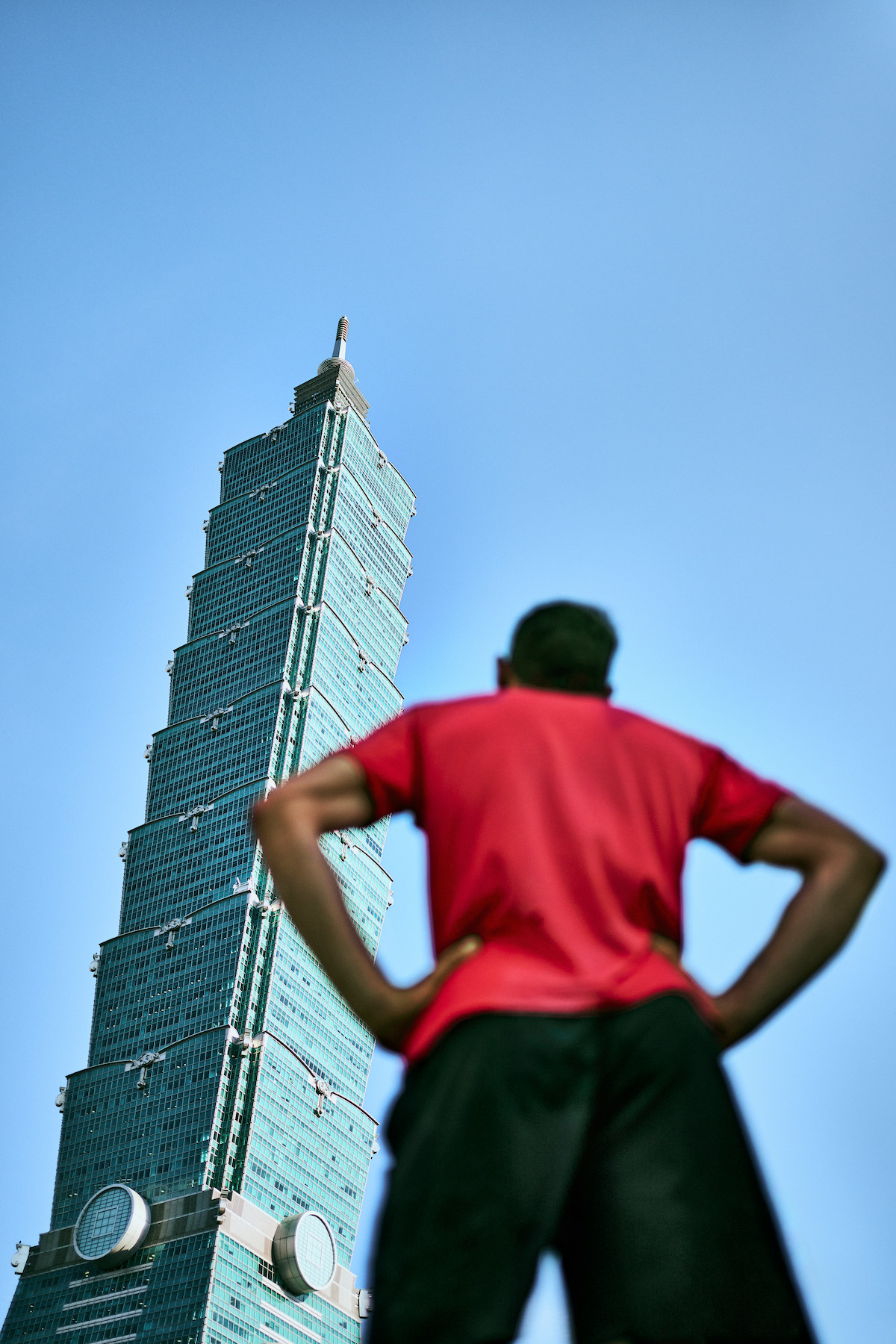
Honnold: I think the hardest part of the climb will be what we’re calling the bamboo boxes, which are eight segments in the middle of the building that are overhanging. Each one is eight floors, so it represents 64 floors in the middle of the building, and they’re all the same.
They overhang, I don’t know, 10 or 15 degrees — it’s kind of steep — and then there’s a balcony every eight floors. In a lot of ways, it actually feels like a climbing pitch, which is the way climbers differentiate segments of a climb.
This means you do quite a hard effort for almost 100 feet and then there’s a balcony, and then you do hard effort for 100 feet and there’s a balcony. So, in a lot of ways, that’s what rock climbing feels like, where you climb for a certain rope length and then you stop. The boxes are definitely the most physically demanding part.
You’re known for calm under pressure. What does fear feel like in your body, and how do you turn it into focus?
Honnold: That’s a good question, because I think even just the framing of the question — “What does fear feel like in your body?” — is the right way to think about it, because in your body it feels a lot like excitement or nervousness, or it’s just like a tingling energy. Let’s just say, an anxiousness about you.
I think that’s one of the ways that you can manage fear a little bit: not get too hung up on whether you’re afraid and just think of it as, “I’m experiencing sensation in my body.” I can either heed that or not — either that means something or it doesn’t. But just because you’re feeling something in your body doesn’t necessarily [mean it has] to have an impact on the way you act.
If something unexpected happens mid-climb, what’s your self-talk or internal protocol in real time?
Honnold: Typically, my self-talk just has to do with taking some deep breaths and calming down my body, because if something happens you typically have a sort of adrenaline response either way.
But with soloing, if something happens, once you’ve registered that it’s happened, it’s already happened — so it’s done and you’re fine, you didn’t fall off. So technically, by the time you realize what’s happening, you’re already good, and what you have to do is calm yourself back down and then return to what you’re doing, which is obviously easier said than done.
I try to take some deep breaths, compose myself, take some time. There’s never any time pressure, so you can spend as long as you need just hanging in one space basically trying to compose yourself.
Have you had to relearn movement or edge grips for this kind of structure? Or, alternatively, what is similar to rock climbing?
Honnold: There’s not anything fundamentally new, because rock climbing is so varied that it kind of encompasses all different types of grips.
I would say that I focused my training a little bit differently just because the building [uses] much more full-body musculature — it’s a little more like a CrossFit workout or something, sort of whole-body fitness and less pure finger strength. So I’ve been prioritizing core and full-body workouts.
What is the one technical detail viewers should watch for that might go unnoticed by the untrained eye?
Honnold: I don’t know. Untrained viewers are just going to think the whole thing looks crazy. They’re just going to be like, “He’s climbing a sheer wall, that’s insane!”
But I think the untrained viewer should appreciate the effort and practice and training that goes into it. Basically, that there’s a plan and I’m executing the plan, and it’s not just willy-nilly and just walk up and try my best.
What’s the highest moment of risk on this climb? Before you go on camera, is there a single move you dread or respect the most?
Honnold: I think that’s actually one of the big differences between climbing a building and rock climbing — there really isn’t a hardest single move.
I think it’s less intimidating than some of the big rock free solos I’ve done. But on the other hand, it means the challenge comes more from the overall physicality of it — just the fatigue that builds over the course of the building — and that’s slightly harder to anticipate.
In some ways, it’s slightly harder. Basically, I don’t know how it’s gonna feel, so it’s more of an unknown.
Beyond reaching the top, what does success look like for you — personally, philosophically, or as an athlete?
Honnold: In this case, I want to feel good while I do it. I’m very confident that I can climb the building, which is why I’m doing this, but I want to have a good time, I want to smile and enjoy myself, I want to have a good experience.
I’ve done a lot of big rock solos in my life, on mountains where some have been incredible experiences, but some have been sort of survival experiences, where I barely get away with something. And afterward I’m slightly traumatized because it’s all really scary. I’m basically not looking to have an experience like that.
My aspiration for the building — over the years, I’ve run a handful of ultramarathons just because trail running goes hand in hand with mountain climbing to some extent. My goal in every ultra is always to not injure myself and to comport myself with dignity. Cross the finish line with a smile, still greet people, have a good time. I feel like my goal for the building is basically the same: not injure myself and comport myself with dignity.
What do you hope viewers feel watching this live — and what do you hope to feel when you step onto that roof?
Honnold: I’m sure viewers will probably be on edge watching this. I assume that most people will be sort of uncomfortable watching the whole thing.
But I hope that viewers get a little bit of my joy from the experience — that they can appreciate the fun of it and the beauty of it, the scenery, just the whole experience. It’s not just extreme sports — it’s more. Hopefully it’ll be fun and cool and beautiful, and they can experience some of the joy of it.
How did the partnership with Netflix come about, and why did you want to broadcast the climb on this service?
Honnold: I think Netflix was willing to take a risk on a live event like this, which is rare, and they’re willing to go for it. That’s the partner you need for a project like this.
I can’t get permission to climb a building unless it’s some kind of event and some kind of show, and there aren’t that many networks who are willing to take on a project like this. So it’s a perfect partnership.
How long have you been preparing for this climbing project?
Honnold: I’ve been climbing full-time for 30 years, so if you count all that as preparation, that’s quite a lot.
The direct, physical training for the building specifically is only maybe two and a half months ahead of time. I’ve been really excited about the building, and I’ve wanted to start training, but basically you don’t want to over-sharpen your sword — you just can’t start training too soon because you burn yourself out, you get injured.
I first saw this building more than 10 years ago, and I’ve hoped to have the opportunity to climb it since then.
How does this climb in Taiwan differ from your previous climbs around the world — or even previous attempts to climb Taipei 101?
Honnold: Taipei 101, as part of its opening ceremony, was climbed by a French climber named Alain Robert with ropes, and he climbed it over four hours — he had just broken his arm or something crazy. He was a great climber in his time; he’s really a skilled soloist, and he’s climbed a lot of buildings around the world.
I think, if I do this, it’ll be the biggest urban free solo ever. I think it’s the tallest building that’s been climbed. I’m not 100% sure, but I think so. I don’t know. But other buildings have been climbed — I think this is just gonna be well documented, well broadcast on Netflix, and I think potentially bigger and a little harder.
Also, I’m hoping to climb it a little better — just to go up on the top, smoothly climb well, and feel great on it. And that’s a subtle distinction that a viewer might not be able to see, but to me it’s important to climb it well. You want to feel good doing it.
You are in a different place than you were when you filmed Free Solo — now a husband and father. Do you approach climbs differently now?
Honnold: Honestly, I’m not in as different a place as people might think. I’m still basically climbing all the time, and it’s more complicated having a wife and kids, and I’m spending more time at home and less time abroad and things like that. But I’m still climbing all the time, so it’s not that different.
But I think my approach is probably more thoughtful than it used to be. I’m preparing more. Part of that is also just being a 40-year-old man now versus being a 23-year-old living alone in my van.
Because when you’re 23, you just go for it — you don’t really care. As a 40-year-old, you’re like, “I’ll just spend the extra day, I’ll do some prep work, I’ll be careful, and it’s fine.”
How will you celebrate once the climb is over?
Honnold: I’ll take the elevator down, I’ll see my wife, we’ll be psyched. We’ll eat at the buffet that night — it’s a really nice buffet — it’ll be great, and that will be the day.
Then I’ll go home, and I’ll go back to my climbing practice.
Plimsoll Productions will produce Skyscaper Live with showrunner and executive producer Al Berman, alongside executive producers Alex Honnold, Grant Mansfield, James Smith, Alan Eyres, and Jonathan Retseck.