


Welcome to Super Bowl LX week at The Ringer! I’ve watched the film, crunched the numbers, and sorted through the noise to identify the 22 most important things you need to know about the Super Bowl matchup between the New England Patriots and Seattle Seahawks. Consider this your Super Bowl LX cheat sheet. Let’s get to it!
Numbers are from TruMedia, Pro Football Focus, and Next Gen Stats unless otherwise noted.
1.
One of the traits I most admire in a football team is a level of consistent competitiveness. You won’t win every game. There’s too much randomness—fluky turnovers, bad calls, injuries, unpredictable weather. But there is something about being in every game that speaks to the actual quality of a team. And in this year’s Super Bowl, we have two teams that are always competitive. While it’s true that the Patriots have faced an easy schedule, it’s still impressive that they have avoided a single blowout. They enter the Super Bowl with a 17-3 record, including the postseason, and each of their three losses was by seven points or fewer. I don’t care what team you’re playing—to go 20 straight games in the NFL without losing by more than a touchdown is hard.
2.
And the same goes for the Seahawks. They’re 16-3, and their three losses were by a combined(!) nine points. Their worst margin of defeat was in Week 1 against the 49ers—a 17-13 loss. So while anything is possible in a one-game sample, there are strong indicators that we’ll (hopefully) get a competitive game and not a laugher like last year’s, in which the Eagles buried the Chiefs by halftime.
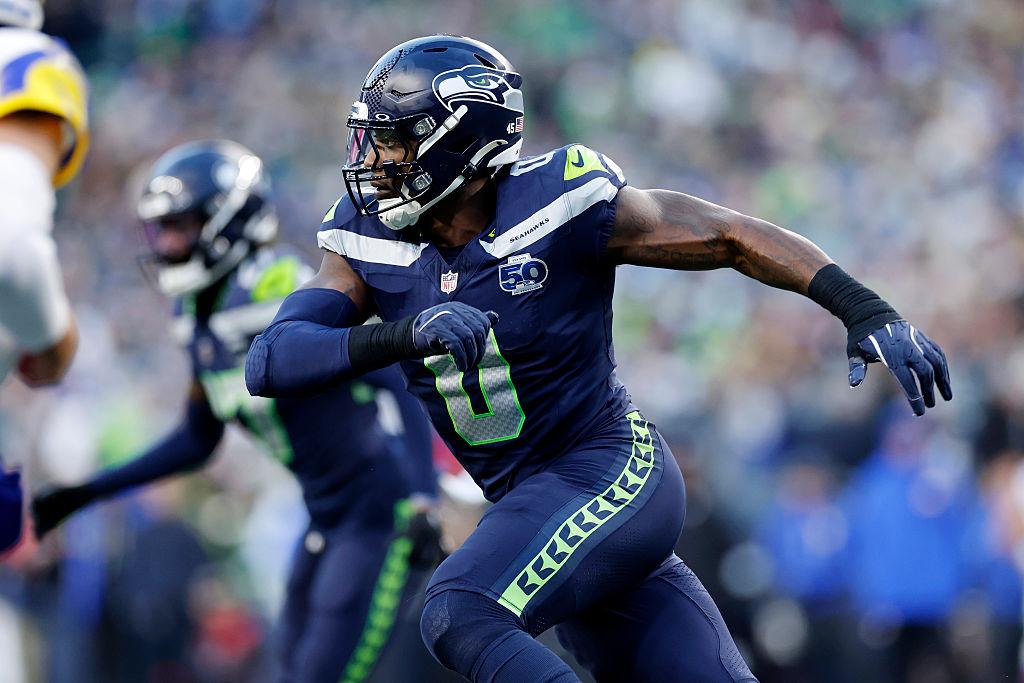
DeMarcus Lawrence during the NFC championship game
3.
When I think about how this game might play out, my attention first turns to this question: Can this Patriots offense score on the Seahawks? Want the glass-half-full take for New England? OK, here goes. If we look at the full 20-game sample, the Patriots have had an excellent offense. They rank fifth in EPA per drive and sixth in success rate. And while the Seahawks have a great defense, it is possible to score on it. We just saw Los Angeles do it in the NFC championship game. The Rams offense produced an 89th percentile game against the Seahawks, piling up 26 first downs and 479 yards. Lighting up the Seahawks defense is not easy. But it is doable.
4.
Now the glass-half-empty take: The Patriots offense has been flat-out terrible in the playoffs. There’s no sugarcoating it. It has looked like a different unit than the one we saw in the regular season.
New England’s Offense in the Postseason
The Patriots have not produced a good offensive game in three tries. And their last two games produced their lowest success rates of the entire season. As a metric, success rate doesn’t weigh explosive plays and turnovers the way EPA does. It just looks at every play as successful or not successful. For example, a 10-yard gain on third-and-8 is treated the same as a 25-yard gain. Both are technically successful outcomes for the offense. I find success rate to be helpful in analyzing how an offense functions if you take away the high-variance plays that are less predictive of general success. And in the last two games, the Patriots offense was not functioning at even a league-average level.
5.
I know what your counter is, Patriots fans! And you don’t need to yell. Against a Broncos team that was starting its backup quarterback, New England’s offense seemed to adopt a “Don’t give the game away” approach. And the weather was a major factor in New England’s last two games. Quarterback Drake Maye has been dealing with a shoulder injury he suffered during the Broncos game. And the Patriots have faced great defenses in January. I understand all of it. These are (mostly) valid excuses! It’s entirely possible that Maye’s shoulder will get healthier with extra rest and the offense will once again start clicking in the Santa Clara climate.
In general, I find larger samples (like the entire regular season) more useful than smaller samples (like the playoffs). But the uncertainty around which version of the Patriots offense will show up feels like the defining factor in predicting the outcome here.
6.
Which leads us to Maye. In the regular season, the second-year passer was a revelation. He navigated the pocket brilliantly. He fired rockets downfield. He made up for an underwhelming offensive line and pass catching unit. Maye finished the regular season first in EPA per pass play and success rate. I had him as my MVP, given that he was dealing with far-from-ideal circumstances and still managed to perform at an elite level. But the playoffs have been a different story. Maybe having a lackluster supporting cast caught up to him. Maybe it’s the shoulder injury. Maybe it was the weather, the game script, the opponents, or some combination of all those things! But it’s been ugly. If we look at the past 10 years, there have been 32 examples of a quarterback making three-plus postseason starts in a given year. Among that sample, Maye this postseason ranks dead last in both EPA per pass play and success rate.
7.
So what exactly is different about Maye in the playoffs? The biggest thing is that he appears to be crumbling under pressure. During the regular season, he was the best quarterback in the NFL (based on EPA per pass play) when pressured. But Maye’s performance under pressure in the playoffs has been abysmal. His EPA per pass play when under pressure in the last three games would translate to the worst number for a quarterback in the NFL if extrapolated over an entire regular season. Pro Football Focus tracks a metric called pressure-to-sack rate. It looks at how often a quarterback is pressured and how often those pressures turn into sacks. During the regular season, the worst pressure-to-sack rate for any quarterback was 25.9 percent (Geno Smith). In New England’s three playoff games, Maye’s pressure-to-sack rate was 45.5 percent! He’s been sacked on over 16 percent of his dropbacks in the postseason—the second-most sacks for any quarterback in a postseason this quarter century. It’s just hard to be good on offense when you’re dealing with so many negative plays.
8.
When Maye has time, he can be extremely dangerous. One of the keys to his MVP-caliber season has been a willingness to make high-degree-of-difficulty throws. Overall, 17.3 percent of Maye’s attempts have been into tight windows—that’s the fourth-highest rate among starting quarterbacks. The Seahawks defense will challenge him. There won’t be wide-open receivers for him to hit. But Maye has shown he’s capable of thriving in that type of environment. Looking at his splits against different defensive coverages, there really is no kryptonite. Maye ranks top five in EPA per pass play against man, zone, single-high safety coverages, two-high safety coverages, the blitz, and four-man rushes. There is not one thing you can point to that consistently gives him trouble.
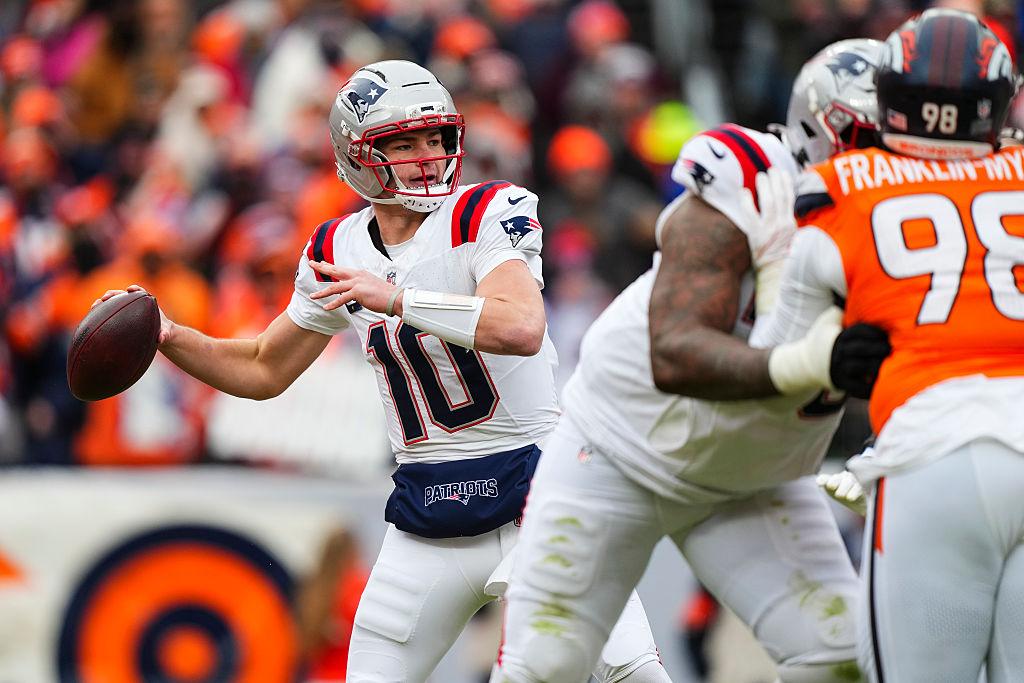
Drake Maye throws the ball during the AFC championship game
9.
You might have figured out by now that I think the Patriots’ chances of a good offensive game rest on their ability to protect Maye against the Seahawks’ four-man pass rush. The Patriots have allowed pressure on 37.3 percent of their pass plays this season, which ranks 25th. The Seahawks have produced pressure on 38.1 percent of their opponents’ pass plays, which ranks fourth. They remain fourth in pressure rate when we filter for plays where they don’t blitz. The Patriots, meanwhile, rank 29th in pressure rate allowed when opponents rush four or fewer.
A lot of this will come down to one-on-one matchups. The strength of the Seahawks’ pass rush is its depth. Seattle has five players—DeMarcus Lawrence, Byron Murphy II, Uchenna Nwosu, Leonard Williams, and Boye Mafe—who have over 40 pressures each. The Patriots’ offensive line doesn’t have to be perfect. It doesn’t even necessarily have to win this battle. It just has to be good enough to give Maye time to hit on a couple of …
10.
Explosives! This is what could decide the game. Maye doesn’t need to complete 70 percent of his passes. The Patriots don’t need to have methodical eight-, nine-, or 10-play drives. The Patriots need to hunt big plays. It’s something they’ve been very good at. Overall this season (with the playoffs included), the Patriots offense ranks first in explosive pass play rate—runs of at least 10 yards and passes of at least 16 yards. Nearly 18 percent of their pass plays have resulted in an explosive gain. Maye ranks first in EPA per pass play on attempts that are 20 yards or more downfield. The Rams showed in the championship round that it is possible to hit those explosives on this Seahawks defense.
On the season, Seattle ranks 13th in EPA per pass play against downfield passes and eighth in explosive pass rate allowed. Now, a lot of that has to do with facing Matthew Stafford, Sean McVay, and Puka Nacua three times. But still, great passing offenses have shown that they can find a way to produce explosives against Seattle. The Patriots must be great in this regard if they are going to pull off the upset.
11.
We have talked a lot about the matchup between the Patriots offense and the Seahawks defense, and we haven’t mentioned New England’s run game. That’s because I don’t think it’ll be much of a factor. The Seahawks have the best run defense in the NFL, according to DVOA. It’s one of the keys to their success. They can play with extra defensive backs and still stop the run. The Patriots rank 24th in rushing success rate on running back runs. Could Rhamondre Stevenson or TreVeyon Henderson break a long one? Sure. But I’d be surprised if we’re talking about an efficient rushing performance by the Patriots in this game.
12.
Maye’s legs, however, are a different story. He probably hasn’t received enough credit for his impact as a rusher. Among 52 players with at least 100 carries this season, Maye ranks second in rushing success rate, behind only Josh Allen. The only three players with a rushing success rate over 50 percent this season are: Allen, Maye, and Jalen Hurts. This metric includes scrambles, designed runs, and sneaks. On scrambles specifically, Maye ranks second, behind only Baker Mayfield, in EPA per game. The Seahawks defense, meanwhile, ranks 16th in EPA allowed on scrambles per game. The Patriots should lean into Maye’s rushing ability in a major way. Option runs, designed runs, quarterback draws, scrambles. There is no saving Maye for the next game. This is the time to fully take advantage of his dual-threat skill set.
13.
On to the other side of the ball! Here’s how the Seahawks offense matches up against the Patriots defense statistically.
Seattle’s Offense vs. New England’s Defense by Advanced Metrics
It’s a pretty even matchup here. The Seahawks have had a very good but not great offense. The difference in the Patriots’ rankings in EPA per drive and DVOA comes down to adjusting for the opponent. DVOA takes opponent strength into account and knocks the Patriots for facing a soft schedule.
14.
The Patriots defense has gotten healthy and appears to be peaking at the right time. They have had four straight games (Week 18 against the Dolphins and their three playoff wins) that rank in the 90th percentile or better in terms of defensive EPA per drive. The Seahawks offense appears to be peaking at the right time, too. Their playoff games against the 49ers and Rams ranked in the 80th percentile or better in terms of offensive EPA per drive. Seattle quarterback Sam Darnold was terrific in the NFC championship round against the Rams, producing a 91st percentile game based on EPA per pass play. It’s true that the driving force behind the Seahawks’ overall success has been their defense. But if Darnold didn’t play at an elite level against the Rams, the Seahawks probably wouldn’t be in the Super Bowl.
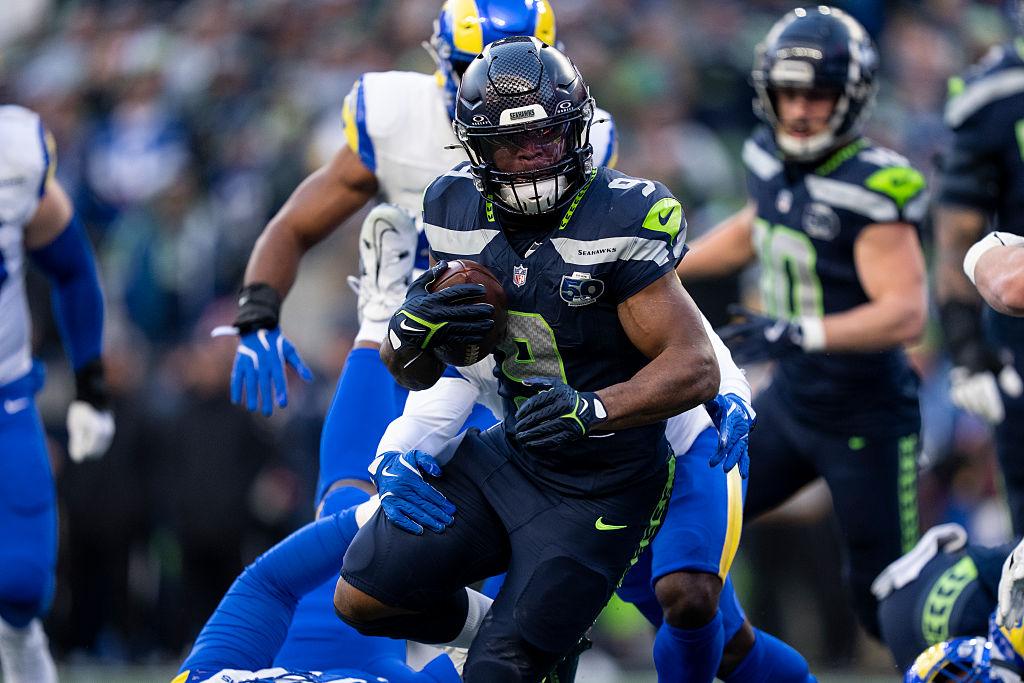
Kenneth Walker III runs the ball during the NFC championship game
15.
The Seahawks have wanted to be a run-first offense all season. They run the ball at the ninth-highest rate on early downs. But they have a Jekyll-and-Hyde run game. Some weeks, Kenneth Walker III looks like one of the best home-run hitters in the NFL. Other weeks, the Seahawks look like they’re running into a brick wall over and over again. Among 55 backs with at least 75 carries, Walker ranks 45th in success rate. But he had 10 runs of 20-plus yards during the regular season, which ranked tied for third among all backs. In other words, there’s definitely a boom-or-bust element to his game. The Patriots right now have a stout run defense. They rank seventh in success rate against running back runs. And on early downs, they are sixth. Walker is capable of breaking a big run at any time, but overall, the Patriots’ run defense has the edge over Seattle’s rushing offense.
16.
Which brings us to the million-dollar question: Can the Patriots make Darnold turn into a pumpkin? It’s a question that Rams fans asked themselves a couple of weeks ago, and Darnold shredded Los Angeles. The Patriots have to decide whether their defensive game plan will focus on making Darnold methodically move the ball down the field or whether they want to prioritize trying to force him into mistakes. Obviously, it won’t be entirely one or the other, and game flow could dictate what direction they lean, but there are cases for both strategies. When opposing teams play split-safety zone coverages—the coverages that force a quarterback to be patient and precise—Darnold ranks 14th in EPA per pass play. If the Patriots are confident that they can stop the run, this could be a nice option. Make Darnold work, try to win with a four-man pass rush, and hopefully force a turnover or two.
17.
Or the Patriots defense could be more aggressive by blitzing and playing more man coverage. On the season, the Patriots have played man at the ninth-highest rate. Darnold has been excellent against man coverage, ranking third in EPA per pass play. A big reason for that: Jaxon Smith-Njigba destroys man coverage. During the regular season, JSN’s 428 yards against man coverage ranked third in the NFL. He averaged 4.16 yards per route run against man coverage, which ranked first. It’s impossible to simply put one corner on Smith-Njigba and shut him down because Seattle will line him up outside, in the slot, and in the backfield. Darnold, meanwhile, has performed better against the blitz than he has against four-man rushes. Bottom line: The Patriots need to choose their spots to be aggressive.
18.
The most interesting splits with Darnold are how he performs when pressured versus how he performs when he has a clean pocket and how he performs with play-action versus how he performs without it. When Darnold is kept clean, he plays like one of the NFL’s best quarterbacks, ranking third in EPA per pass play. But on snaps when he’s pressured, Darnold drops all the way down to 28th in EPA per pass play—sandwiched between Tua Tagovailoa and Mac Jones. That’s one of the biggest discrepancies you’ll find for a quarterback. On the season, the Patriots have produced pressure at the ninth-highest rate of any defense. The Seahawks have allowed pressure at the fifth-lowest rate. The team that wins the battle up front when Seattle has the ball could very well be the team that wins the game.
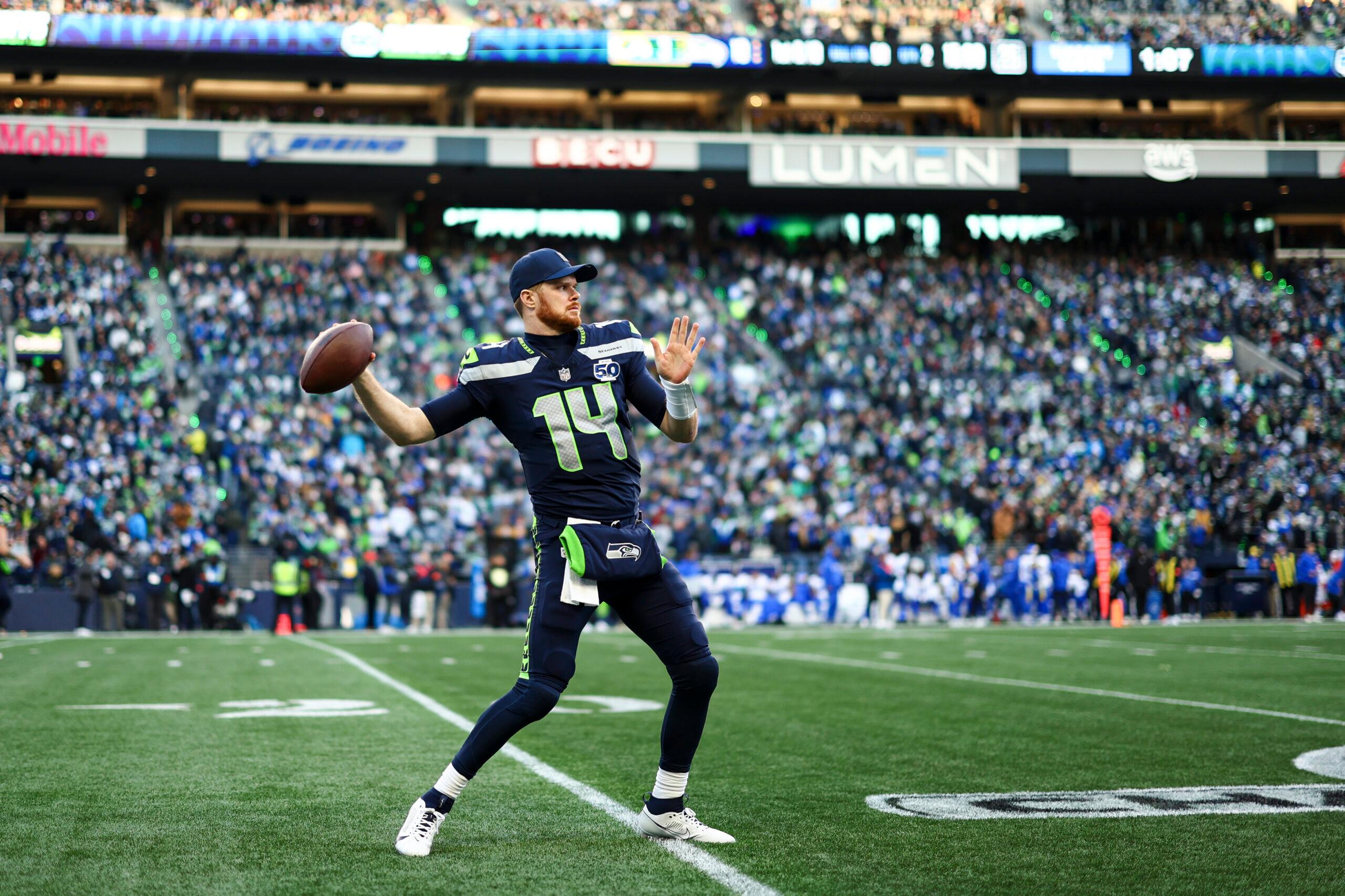
Sam Darnold throws a pass during a timeout in the NFC championship game
19.
It’s impossible to talk about the Seahawks offense without focusing on its use of play-action. Offensive coordinator Klint Kubiak does a good job of not being one-dimensional and not revealing whether the Seahawks are going to run or pass. On early downs, Darnold ranks fourth in EPA per pass play. And when he uses play-action, he ranks second in EPA per pass play. Play-action on early downs is one of the biggest cheat codes in the sport. Defenses have to be ready for the run or the pass, and you can catch them guessing wrong and open up voids to create explosive plays. On late downs, that becomes a lot harder. On late downs with 6 or more yards to go, Darnold ranks 26th in EPA per pass play. This is where the Patriots defense wants to be—in a world where it knows Darnold has to drop back and pass.
20.
Although Darnold’s numbers drop off on late downs, he is an incredibly efficient downfield passer. Earlier, I mentioned that Maye is first in EPA per pass play on attempts 20-plus yards downfield. Darnold is second. The Patriots defense ranks ninth in EPA per pass play against deep passes, and it allows explosive pass plays at the fourth-lowest rate. I feel the same way about Darnold as I do about Maye: I don’t think this has to be an efficient game where Darnold completes 70 percent of his passes. If he can avoid turnovers and connect on enough explosive completions, that will probably be enough for a Seahawks win.
21.
So much about evaluating the Patriots defense comes down to whether or not you believe your eyes. According to DVOA, they faced the easiest schedule of opposing offenses in the NFL. But there is still a lot to like here. The Patriots’ blitz schemes were quite effective. They ranked third in EPA per pass play when they blitzed. Remember how I mentioned the importance of play-action to the Seahawks offense earlier? Well, the Patriots defense has been excellent against play-action, ranking second in EPA per pass play. The Patriots are well-coached, and they have talent at key spots like defensive tackle and corner. Maybe late Sunday night, we’ll view their defense as a fraudulent unit that beat up on a bunch of weak opponents. But going into the game, count me as someone who believes it’s pretty good and can keep the Seahawks offense in check here.
22.
Let’s finish with some narratives. If Mike Vrabel’s Patriots win, I think it’ll be because one of two things happened. One, Maye put the team on his back. He’s certainly capable. If he plays well against this Seattle defense, nobody will remember his performances in the three playoff games before this. It will be an MVP-caliber season topped with an epic performance against an elite defense—all at the age of 23. That’s all-time stuff. Or two, the Patriots defense feasted on Darnold’s mistakes. The Seahawks QB has had a great season, but he still ranks 20th in turnover-worthy play percentage. If the Patriots can get a couple off of Darnold, they’ll have a great chance to steal the game.
If the Seahawks win, we’ll probably be talking about how we should have seen this coming. They are the sixth-best team since 1978, according to DVOA. They’ve been a great team for most of the season. There would be nothing surprising about a convincing Seattle win. We’d be talking about Mike Macdonald as an elite coach, Darnold’s one-of-one career arc, and the phenomenal job John Schneider did to reset this team in the post–Pete Carroll era.
Seahawks-Patriots! Darnold-Maye! Vrabel-Macdonald! Just like everyone predicted back in August. Enjoy (or don’t) the 4,000 Malcolm Butler replays. My official game prediction is coming later this week on The Ringer and The Ringer NFL Show.

Sheil Kapadia
Sheil Kapadia writes about the NFL and hosts two podcasts: ‘The Ringer NFL Show’ and ‘The Ringer’s Philly Special.’ Prior to joining The Ringer in 2022, you could find his work at The Athletic, ESPN, and Philadelphia Magazine.


