

-
This article has been translated from the original Japanese content.
-
This interview was conducted before the game was released.
In this 22nd volume of Ask the Developer, an interview series in which developers convey in their own words Nintendo’s thoughts about creating products and the unusual details they hone in on, we’re talking to the developers behind Splatoon™ Raiders, a Nintendo Switch™ 2 exclusive game that launches on July 23, 2026.
Check out the rest of the interview
Part 1: The ultimate multitasker
First, can I ask everyone to briefly introduce yourselves?
Seita Inoue (referred to as Inoue from this point on): Hello, I’m Seita Inoue, the producer for Splatoon Raiders. I’ve been involved with the Splatoon series since the first Splatoon game for Wii U™. For Splatoon Raiders, I oversaw the entire development process and charted a new course for the series.
Yoshihiko Ito (referred to as Ito from this point on): Hello, I’m Yoshihiko Ito, the director. Within the Splatoon series, I’ve mainly worked on Salmon Run. I served as a planner for Splatoon 2 and lead planner for Splatoon 3. I directed the overall structure and gameplay for Splatoon Raiders.
Koji Sonoyama (referred to as Sonoyama from this point on): Hi, I’m Koji Sonoyama, the art director. In terms of the Splatoon series, I led the UI (1) development for Splatoon 3 and oversaw all of Splatoon Raiders‘ artwork.
(1) An abbreviation of “User Interface.” Refers to parts of the game screen which indicate how players can interact with the game through button controls and menu screen options.
Shu Tamura (referred to as Tamura from this point on): Hi, I’m Shu Tamura, the sound director. As a sound design lead on Splatoon 3, I worked on creating sound effects for battles and adjusting the overall sound balance. As the sound director for Splatoon Raiders, I oversaw the overall sound direction, including background music, while also carrying over my sound-balancing responsibilities from Splatoon 3.
Thank you very much. Without further ado, could you briefly explain what kind of game Splatoon Raiders is?
Inoue: Of course. Splatoon is a series in which mysterious squids, who can change into humanoid form, battle to claim turf using ink. Splatoon Raiders is a spin-off title in that series. While preserving the Splatoon series’ fundamental controls, this game is designed as a more focused, single-player experience, rather than a competitive one.
Ito: One of the major features is the introduction of “gadgets,” which players can use to dynamically expand their range of actions. For example, leaping high into the air, performing powerful charges, or throwing multiple devices. You can also upgrade your character and leverage a wide range of customization options, letting you fully explore your preferred battle style.
After Splatoon 3, I would’ve expected the next release to be “Splatoon 4,” but instead it turned out to be a spin-off―what led to that decision?
Inoue: We’ve been going full speed ahead for over 11 years since the series’ launch, developing and updating three titles along the way. We thought it might be interesting to create something with a slightly different approach to gameplay, where you can really savor the action on your own. Splatoon isn’t just about competitive play; it also includes cooperative modes like Salmon Run and a single-player Story Mode. So, one of our motivations for developing this game was our desire to create a new entry point into the series by releasing these non-competitive elements not just as a secondary feature, but as a standalone spin-off. That said, we will continue to develop competitive gameplay going forward. That’s why we developed this game as a spin-off and not as “Splatoon 4.”
Ito: Originally, around the time our work on updates to Splatoon 3 was winding down, we were exploring whether we could develop a single-player experience that players could dive into to their heart’s content, leveraging the gameplay of Salmon Run. Salmon Run is a part-time gig for squids, where four players* team up to take down Salmonids and collect Golden Eggs. We thought that if we could adapt it for single-player, it might result in something hectic yet exhilarating. We’d discussed developing the next Splatoon game for Nintendo Switch 2, and that being the case, we thought we could really take advantage of the system’s performance. This prompted various experiments, such as ramping up the number of Salmonids for the “ultimate multitasker” experience, where a single player battles them all.
Salmon Run is a four-player co-op mode, and even then, things can get pretty busy, right? How would that work in single-player?
Ito: Yes, like you said, Salmonids in Salmon Run are designed with four-player co-op in mind, so dealing with them alone would be extremely difficult. So, the first thing we tried was building gameplay around placing traps. The idea was to place traps all over the place and to fight alongside them. Here’s some development footage from that time.
The traps are being triggered automatically…so it’s like a base defense game (2).
(2) Games in which players strategize to defend their base from waves of enemy attackers.
Ito: Yes, exactly, at first it was very much like a base defense game. We created a prototype where you place lots of traps and deal with waves of incoming Salmonids. However, the more we explored, the more it felt like you were just building a fortress with lots of traps and then watching it play out. It didn’t really feel like a Splatoon game to us.
Right, so when the gameplay was centered around placing traps, it lost its «Splatoon-ness.»
Ito: That’s right. In Splatoon games, you perform loads of different actions within a short period of time―fighting enemies, inking the ground, changing in and out of squid form, jumping from one place to another, and so on. We think the intensity of the action is one of the game’s key strengths. But when the core gameplay shifts to building a fortress and fighting off enemies, it becomes difficult to make the most of that strength.
Inoue: When we look back at the early days of the series, at first, the fun came from the sense of unity between the player and the character through gyro controls on the Wii U GamePad, combined with the ink-shooting mechanics. Having now developed three titles in the series plus their DLCs, we’ve had both competitive and non-competitive gameplay, but no matter what, as long as there’s that strong sense of action and unity with the character and the ink, it always feels like you’re playing Splatoon. But with traps, we couldn’t recreate that feeling.
Ito: That realization was a turning point for me. From there, we made a major shift, away from gameplay centered on building a fortress to defend against enemies. We focused instead on expanding the range of actions available to the player to be more dynamic, so they can actively take down enemies themselves.
As we organized ideas of how to expand players’ actions, the concept of “gadgets” emerged. Players can equip gadgets to charge forward with power or leap high into the air, place gadgets that let you hover briefly above them, and so on. We designed it with the idea that players’ actions would differ depending on the gadget they use.
Definitely, rather than having players place traps and wait, gameplay that keeps them constantly on the move with various gadgets feels like it expands on the fun of that signature Splatoon action.
Inoue: Also, I think the satisfaction of playing Salmon Run comes from how you start moving the instant you think. So it’s like you’re sort of thinking, but sort of not…or rather, you react before you can think. In sports, we often refer to being “in the zone,” and I thought that level of immersion might be really satisfying in a video game too. And it’s not just sports―busy jobs offer a similar sense of satisfaction, don’t you think?
Ito: Yes, that’s right. We designed this game with the goal of creating an experience where players can feel that same sense of pleasant busyness. In addition to weapons, players can equip two gadgets, with the flexibility to choose whichever’s most effective in the moment against the hordes of attacking Salmonids. Once a gadget has been used, it can’t be used again for a certain period of time, but by rapidly swapping between a weapon and two gadgets, players can minimize downtime and efficiently take down a large number of Salmonids. Once I’d experienced the satisfaction of busily alternating between gadgets, I really felt like this could become the core gameplay. That’s when I felt like, “I’m the ultimate multitasker!”
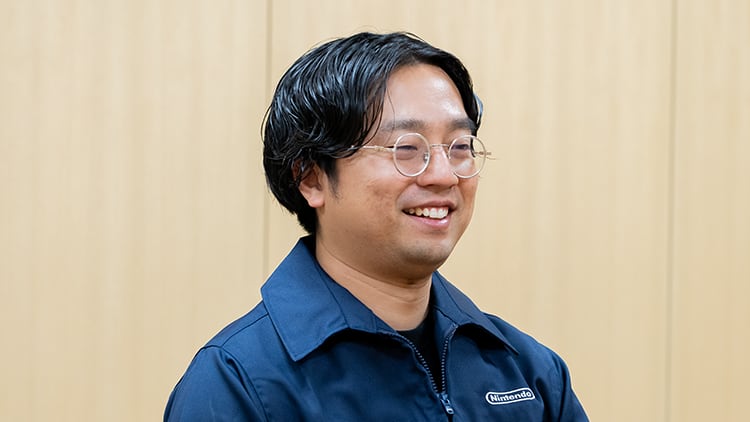
Inoue: So we decided to build the gameplay around making use of multiple gadgets and weapons to take on large numbers of varied Salmonids, and it turned out to be the most hectic game screen I’ve ever seen. (Laughs)
With so many things happening at once, didn’t that make design and sound creation a bit challenging?
Sonoyama: It definitely did. By the time I got my hands on it, the gameplay direction was already somewhat fixed, but the difficulty level was off the charts! (Laughs)
Sonoyama: I think part of that was because I was working with an early prototype that wasn’t very easy to control, while not yet having developed the ability to think about multiple things at the same time. Even so, as a UI designer, I was shaking in my boots. (Laughs) Of course, it was fun once I got the hang of it, but I felt that there were significant barriers I needed to overcome, both as an art director and UI designer, to ensure all players could get to that point.
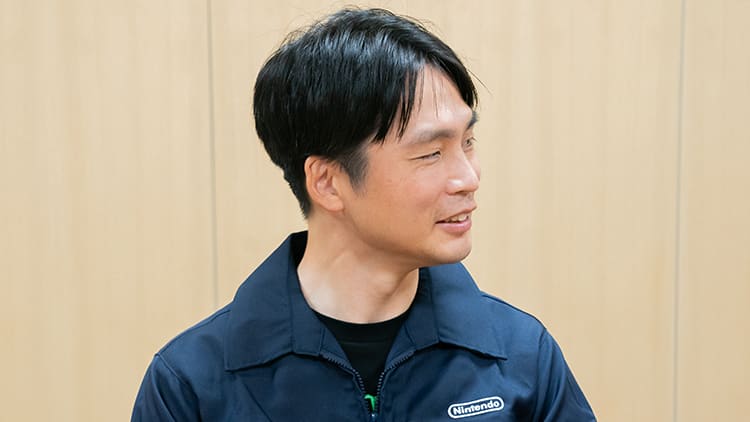
Tamura: From a sound perspective, I was stressing big time, thinking about how to bring all that busyness together. (Laughs)
Sonoyama: I can imagine. While it’s important for the game to feel busy and fun, how quickly and easily players can grasp the situation amid all that chaos also has a major impact on how it feels to control. If you’ve been attacked from behind without realizing it, the reason for your defeat becomes unclear and it can feel unfair, so we used sound effects to help address that.
Tamura: This is something we were already mindful of in Salmon Run, but in this game, which combines even more elements for some really complex situations, we focused heavily on making it possible for players to understand what’s going on through sound. For example, we tried tweaking the sound effect that plays when a Salmonid is hit, based on the amount of damage being dealt. We experimented with various other things to make player’s actions clear and feel cool.
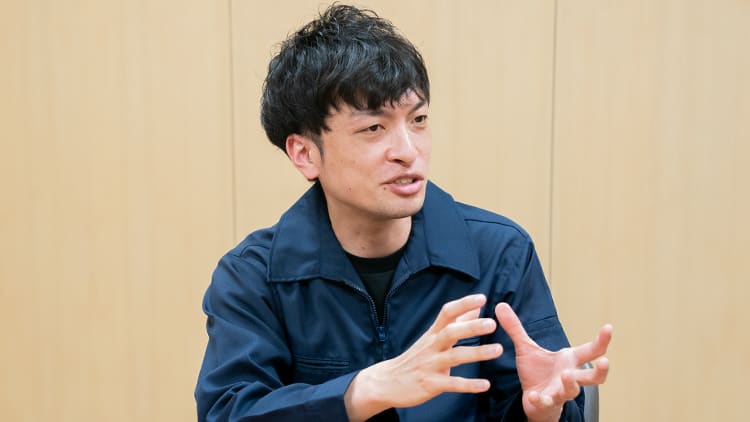
Ito: In terms of the overall flow of the game, we designed it so that the level of busyness gradually escalates, allowing players to learn the mechanics as they go along. We wanted to ensure that as many people as possible can experience that sense of pleasant busyness. So, the whole team worked together to polish things like how easy it is to read the situation or get used to the controls.
You’ve talked about putting effort into the design and sound to make it easier to understand what’s going on in busy situations. Let’s circle back to the gadgets, which are a key gameplay element in this title. What kinds are there?
Ito: During brainstorming, we had so many ideas for gadgets. The team brainstormed freely on the theme of expanding the player’s range of actions, and came up with a variety of ideas.
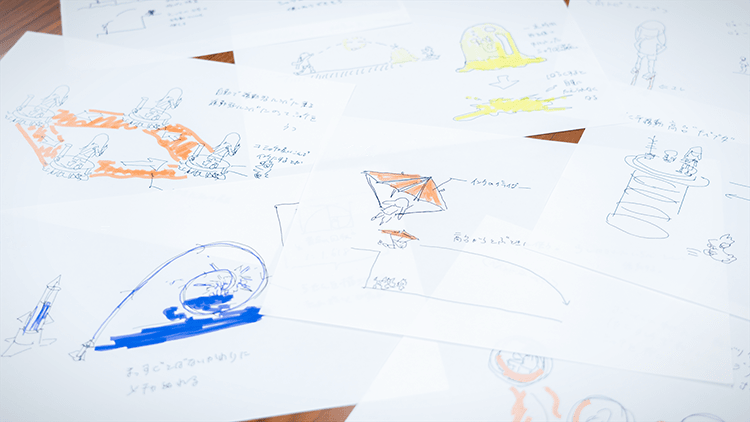
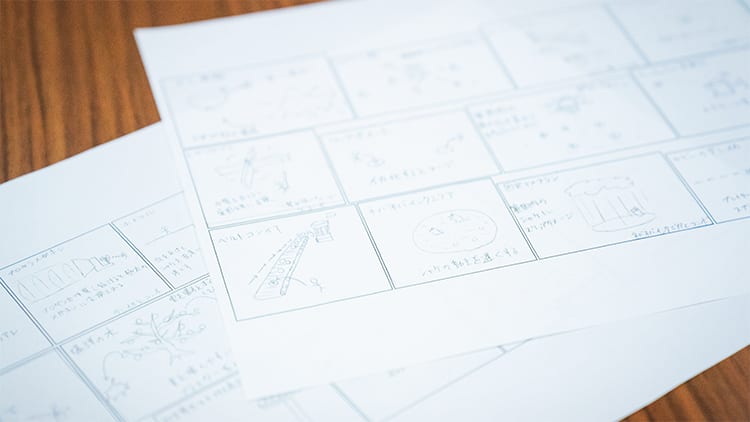
We’d started building the gameplay around the idea of traps, so there were lots of gadgets designed to be placed on the ground. Also, since the original objective, much like Salmon Run, was to collect Golden Eggs from defeated Salmonids and deliver them to a container, we even came up with a conveyor belt-like gadget that could automatically transport a large number of Golden Eggs. (Laughs)
Oh, so that idea didn’t make it into the final game?
Ito: That’s right. We considered a lot of ideas and did a lot of experimenting, but we felt that it would put greater focus on this game’s intense, gadget-focused action if we removed the element of bringing back Golden Eggs to the container. However, we felt it would be more interesting for players if they had a reason to move around, so we kept the part where you collect the Golden Eggs, but removed the need to take them back to the container. By tweaking the objectives like this, we narrowed down the gadgets to those that keep the focus on defeating enemies.
I see. So, while you simplified the functions of gadgets, you also made them customizable.
Ito: One of the important new features we’ve added in this title is the ability to collect parts and materials by defeating various Salmonids and then use them to customize and enhance gadgets. Not only can you boost a gadget’s attack power, you can also make its actions more dynamic and diverse.
Inoue: It’s like witnessing highly trained professionals at work, for example, preparing food at a food truck or packing goods on a production line. It’s like they’re moving at superhuman speed, right? True artisans whose bodies seem to just move naturally. But even they started out as beginners and, through steady practice, eventually reached a level that looks superhuman to us. This game is no different. You start off with simple gadgets and gradually expand your capabilities as you grow more comfortable. By repeating this process, you’ll eventually reach a point where you can perform actions that seem almost impossible.
Ito: By strengthening both their equipment and their own skill in this way, we believe players will eventually become what we call the “ultimate multitasker.”
Read more in Part 2: I’ve wound up in an outlandish environment
*Additional games, systems, and/or accessories may be required for multiplayer mode. Games, systems, and some accessories sold separately.


