

Few franchises have such a complex lore as Dune. In Dune: Part Two, Denis Villeneuve explores many elements of the original Frank Herbert novel while also elevating some of them with original ideas. One of those is the Bene Gesserit, the ancient sisterhood that has been pulling the strings of nearly every major galactic event for millennia. They are present everywhere, from laying the seeds of the Fremen prophecies on Arrakis to plotting the demise of House Atreides with House Harkonnen and the Padishah Emperor Shaddam IV Corrino (Christopher Walken). But the scene that defines them is also one of the movie’s best and most underrated: when Lady Margot Fenring (Léa Seydoux) applies the Gom Jabbar test to Feyd-Rautha Harkonnen (Austin Butler) on Giedi Prime. It’s the same test applied to Paul Atreides (Timothée Chalamet) in the first Dune movie, but, this time, there are very different intentions behind it.
Feyd-Rautha’s Gom Jabbar Test Is Very Different From When Paul Atreides’ Took It
Feyd-Rautha is the heir to Baron Vladimir Harkonnen (Stellan Skarsgård), and his introduction in Dune: Part Two happens in a gladiator arena during his birthday celebrations. The sequence is grand in every way. The black sun of Giedi Prime painting everything in chalky black and milky white, Feyd-Rautha’s psychopathy in the arena, how the people worship him… It’s all very impressive from a visual standpoint, but what comes next manages to be even more impactful because, despite Feyd-Rautha seeing himself as a predator, he actually becomes the prey, targeted by Lady Margot and her ulterior Bene Gesserit motives.
After his psychotic birthday bash, Feyd-Rautha walks through the corridors of the Harkonnen castle in Giedi Prime by himself, followed by Lady Margot. He puts a knife to her throat and asks her what she’s on about, but the tables quickly turn. After playing coy at first, she quickly gets him under her control and leads him to the guest wing of the castle, where he has never been before. Feyd-Rautha is clearly out of his element, and what he does now isn’t up to him anymore. He follows Lady Margot into her chambers, where she commands him to kneel and put his hand on a box, a Gom Jabbar needle to his throat now. He evidently passes the test, as he’s still alive for the remainder of the movie and has his two hands, and, in the next scene, Lady Margot reports on the test and on securing his Harkonnen bloodline by conceiving a girl with him to Reverend Mother Gaius Helen Mohiam (Charlotte Rampling) and Princess Irulan (Florence Pugh), who’s also a Bene Gesserit. Plans within plans.
Feyd-Rautha’s experience with the Gom Jabbar is very different from when Paul Atreides takes the test in the first movie. Back then, it is mostly about Reverend Mother Mohiam chastising Lady Jessica (Rebecca Ferguson) for defying her orders and conceiving a son, Paul, instead of a daughter for Duke Leto Atreides (Oscar Isaac) as planned. Now, it’s all about finding someone who can potentially stand up to Paul after he has already become a leader among the Fremen. Lady Fenring completely dominates Feyd-Rautha, to the point where she doesn’t even have to use the Voice to make him comply. She identifies all his weaknesses, gets what she came for, and leaves him. He is a psychopath who murdered his own mother, and seeing him reduced to an almost animalistic state is even satisfying to a point, because it reveals a lot about what the Bene Gesserit really want and how they act to get it.
Feyd-Rautha Is the Best Alternative for the Bene Gesserit To Retain Their Power
In Dune: Part Two, the Bene Gesserit play a larger role than in Villeneuve’s first Dune movie. Reverend Mother Gaius Helen Mohiam is present for most of the important events, and we meet other members of the Sisterhood, like Lady Fenring and Princess Irulan themselves. Not just that, but Reverend Mother Mohiam also reveals that she convinced the Emperor that House Atreides needs to be annihilated, something that speaks of the influence the Sisterhood holds in the political sphere in the Dune universe and how they are always focused on consolidating and perpetuating their position.
When it’s discovered that Paul Atreides not only survived, but is also leading a crusade against the Empire’s dominion over Arrakis, this is an immediate threat to the Bene Gesserit for a number of reasons, from possibly disrupting the flow of spice as a commodity, to reestablishing House Atreides as a major power in the universe. For millennia, the Sisterhood has built a position in which they aren’t openly in power, but rather behind it, pulling strings and making arrangements towards their ultimate goal. The political structure of the Empire is similar to Middle Age fiefs, with lords and vassals, and the Bene Gesserit have been articulating the movements of every political player, from the smallest to the biggest, for millennia. Using their influence, they are present in every court and advise every lord, while also being present among ordinary people, both in big urban centers and on remote planets, like Arrakis. They have managed to gather this much influence through the heavier use of spice, which granted them prescience and abilities superior to those of an ordinary person – enough to make them feared and respected even among high-borns like Feyd-Rautha.
Reverend Mother Mohiam advising the Emperor to exterminate House Atreides is a major departure from the original Dune novel, but one that works, in the sense of how it highlights just how insidious the Bene Gesserit can be to perpetuate their influence and status. House Atreides rose as a potential threat to the Emperor’s rule and, by proxy, the Sisterhood’s own condition as advisors of power. One of the signs that the Atreides posed a risk is the very fact that Lady Jessica defied her orders to bear a daughter to Duke Leto – Jessica is a Bene Gesserit herself, but disobeyed her direct orders for the love she had for her husband. The fact that the Atreides were capable of inspiring such sentiment was dangerous for the political order of the Empire, and is what ultimately motivated the Bene Gesserit to plot their downfall.
Paul Atreides is aware of the Bene Gesserit’s involvement in his father’s death and the destruction of his house. His ascension on Arrakis puts the Sisterhood in a delicate position, because it’s something they hadn’t foreseen. For them, the best possible outcome to the whole Arrakis affair is Paul’s crusade being defeated, which is why Feyd-Rautha becomes such an important puzzle piece for them. For that to happen, however, the Bene Gesserit had to find out if he could be controlled. This was Lady Fenring’s most important mission regarding Feyd-Rautha: finding out if he could be a tool to defeat Paul, allowing them to keep their status. She succeeds in learning about his mind and what drives him – «desire and humiliation,» according to Reverend Mother Mohiam – and that he can be controlled through pain and his «sexual vulnerability,» as Lady Margot states. Much easier to understand and control than Paul Atreides.
Lady Fenring Uses Feyd-Rautha as Part of the Bene Gesserit’s Eugenics Program
Another purpose of Lady Fenring’s mission in Giedi Prime is related to another of the Bene Gesserit’s machinations. Apart from their political role, the Sisterhood also has a crucial role as a religious organization in the Dune universe. While the Imperium has no official religion, they are looked upon as spiritual guides, and have their own internal beliefs and rituals in this sense. The Gom Jabbar test is one of them, meant to assess whether a man is a prospect to be the Kwisatz Haderach – the man who will save humankind from stagnation and lead it to a new age of enlightenment.
The arrival of the Kwisatz Haderach, however, will only happen through one of the Bene Gesserit’s most insidious practices – eugenics. Over the millennia, they have set in motion a secret breeding program between the Great Houses, using their influence to cross members of these houses until a man is born who has the correct genetic crossing to be the Kwisatz Haderach. According to the Bene Gesserit’s eugenics plan, the Kwisatz Haderach is supposed to be finally born from a crossing between houses Atreides and Harkonnen – an Atreides female and a Harkonnen male. However, Lady Jessica’s decision to bear Duke Leto a son once again thwarts their plans, leaving House Harkonnen’s genetic line in danger.
This is another reason for Lady Fenring’s mission in Giedi Prime: to secure Feyd-Rautha’s genetic line by bearing his daughter. To ensure the continuity of their eugenics program, many of the Bene Gesserit themselves act as concubines to the great houses. Lady Jessica herself never married Duke Leto, being only his concubine, but the fact that a Bene Gesserit’s past is supposed to be secret meant that she never knew she was the daughter of Baron Vladimir Harkonnen, so her having a son meant the crossing between Atreides and Harkonnen happened one generation earlier, making Paul the Kwisatz Haderach.
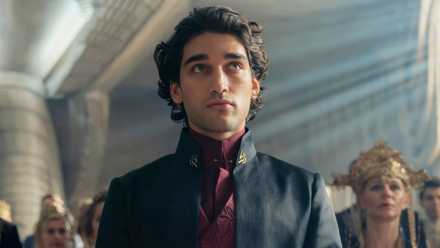
HBO’s Epic Sci-Fi Prequel Series Gets a Galaxy-Shaking Update on Season 2 [Exclusive]
The science-fiction prequel series is streaming on HBO Max.
The Scene Between Feyd-Rautha and Lady Margot Is Original to Denis Villeneuve’s Movie
Denis Villeneuve promotes many changes in his movies from the original Dune novel, and the scene between Feyd-Rautha and Lady Margot Fenring is among the biggest ones. She is a relevant character in the novel, also deeply loyal and in line with the Bene Gesserit, but her direct involvement in the story is much smaller, mostly as the wife of Count Hasimir Fenring, who is himself a close advisor to the Emperor. They are the ones who supervise the change of power from House Harkonnen to House Atreides on Arrakis, and she leaves notes to Lady Jessica warning her of the plot to destroy her family. Count Fenring was supposed to be played by Tim Blake Nelson in Dune: Part Two, and scenes were even recorded, but, sadly, they ended up cut from the final version.
Like in the movies, Lady Margot is a crucial part of the Bene Gesserit breeding program, and is also tasked with securing the Harkonnen bloodline through Feyd-Rautha. Her own husband, Count Fenring, was once a Kwisatz Haderach prospect, but can’t have children of his own. They have such a close relationship, that he is even aware of her missions and duties as a Bene Gesserit, and is often complicit. She also succeeds in securing the Harkonnen bloodline, but the books never mention what happens to the child afterward, and House Harkonnen continues with a diminished and only indirect involvement in the main plot.
Even though it’s a departure from the story told in the book, the scene between Feyd-Rautha and Lady Margot in Dune: Part Two is a great addition to Dune lore, even without Count Fenring’s involvement. Not only does it shed light on Feyd-Rautha as a character and makes him a more complex challenge to Paul Atreides in the audience’s eyes, but it also highlights the coldness and objectivity with which the Bene Gesserit operates. In the books, this scene is only mentioned, but actually showing things happening has a striking effect on the story, especially since Lady Margot later provides a firsthand report of her findings from a purely objective point of view, focusing only on him as the object of her mission and nothing more.
These themes are futher explored in the HBO Max series Dune: Prophecy, and likely as well in the upcoming sequel Dune: Part Three.

Dune: Part Two
- Release Date
-
February 27, 2024
- Runtime
-
167 minutes
- Director
-
Denis Villeneuve
- Writers
-
Denis Villeneuve, Jon Spaihts, Frank Herbert


